
- Written by: admin
- March 17, 2026
Introduction
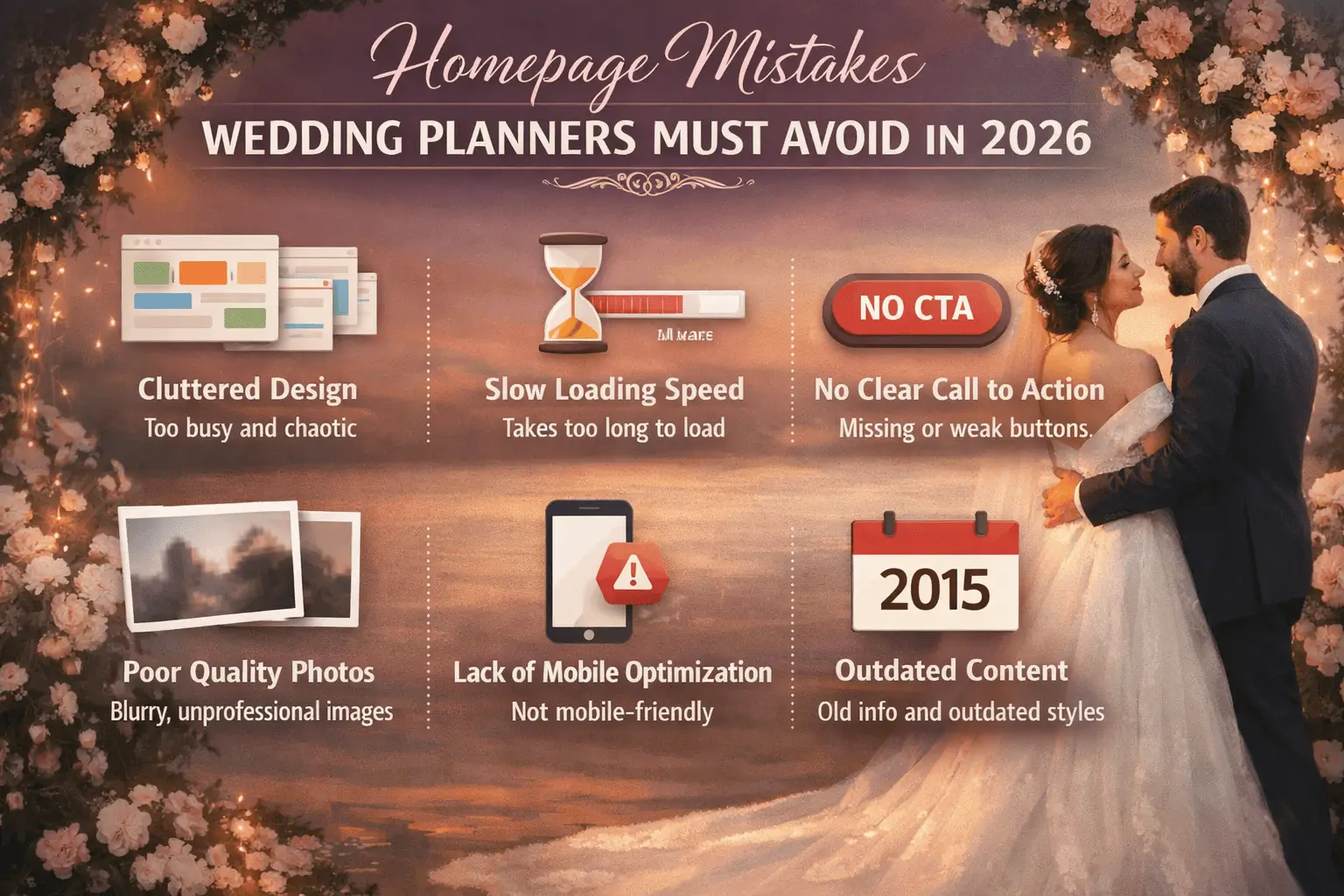
Homepage mistakes wedding planners must avoid can significantly impact your ability to attract and convert clients. In the highly competitive wedding planning industry, your homepage serves as the first impression for potential clients, making it crucial that it is both functional and appealing. A poor homepage can turn away potential clients before they even explore your services, while a well-optimized homepage can boost your bookings and establish your credibility.
In this guide, we will cover the most common homepage mistakes wedding planners must avoid in 2026. By ensuring that your homepage is clean, fast, and easy to navigate, you’ll increase your chances of turning visitors into loyal clients.
As a wedding planner, your website’s homepage is often the first impression potential clients will have of your business. In 2026, with the ever-increasing competition in the wedding planning industry, your homepage must not only look aesthetically pleasing but also be functional, user-friendly, and optimized for conversions.
However, many wedding planners unknowingly make homepage mistakes that hurt their chances of converting visitors into clients. In this guide, we’ll cover the most common homepage mistakes wedding planners must avoid in 2026 and how to fix them. By ensuring your homepage is well-optimized, engaging, and conversion-friendly, you’ll increase your chances of attracting high-quality leads and turning them into loyal customers.
1. Cluttered and Overwhelming Design
One of the biggest mistakes wedding planners make is creating a homepage that is too busy or cluttered. A visually overwhelming design can confuse visitors and drive them away. Your homepage needs to be clean, simple, and organized to ensure a smooth user experience.
What to Avoid:
Overloading your homepage with too many images, texts, or pop-ups.
Using too many different fonts, colors, or styles that don’t align with your brand.
Lack of clear organization in terms of sections and navigation.
Solution:
Focus on a minimalist design with plenty of white space.
Use a consistent color scheme and typography that aligns with your brand image.
Make sure important information is easy to find with clear headings and organized sections.
2. Slow Loading Speed
In 2026, a slow-loading homepage can hurt your website’s user experience and search engine ranking. Studies show that nearly half of visitors will leave a website if it takes more than 3 seconds to load. As a wedding planner, you don’t want potential clients to leave your site before they even see what you offer.
What to Avoid:
Large, unoptimized images or videos that slow down load times.
Excessive use of animations, pop-ups, or scripts that hinder performance.
Solution:
Optimize your images and videos for the web. Tools like TinyPNG or ImageOptim can compress large files without losing quality.
Minimize the use of heavy scripts and unnecessary animations.
Test your homepage speed regularly using tools like Google PageSpeed Insights and make improvements based on the results.
3. Unclear Value Proposition
If your homepage doesn’t clearly communicate your value proposition—why someone should choose your wedding planning services—visitors will likely leave without taking further action. Your value proposition should be front and center, answering the question: “Why should I hire you as my wedding planner?”
What to Avoid:
A vague or confusing headline.
Failing to address your unique selling points (USPs) directly.
Lack of a clear explanation of how your services can benefit the client.
Solution:
Include a clear and concise headline at the top of your homepage that explains what you do and how you can help clients. For example, “Expert Wedding Planning for Stress-Free Celebrations.”
Highlight your USPs with a brief description of what sets you apart—whether it’s your experience, specialty in destination weddings, or personal approach.
Use subheadings or bullet points to make your value proposition easy to read and understand.
4. Lack of Clear Call-to-Actions (CTAs)
A homepage without clear call-to-action buttons is like a road with no signs—your visitors won’t know what to do next. CTAs are essential for guiding potential clients through their journey on your website, from exploring your services to booking a consultation or contacting you.
What to Avoid:
No visible buttons for booking a consultation or contacting you.
Vague or unclear CTAs like “Learn More” or “Click Here.”
No immediate way to get in touch with you, especially for urgent inquiries.
Solution:
Place a clear CTA above the fold (the area that’s visible when a visitor first lands on your homepage) that encourages visitors to take action—e.g., “Schedule a Free Consultation” or “Get Your Wedding Planning Quote.”
Use action-driven, specific CTAs like “Get Started,” “Book Your Consultation,” or “Request a Quote” instead of generic phrases.
Include CTAs throughout the page, especially after showcasing services or success stories, so visitors know exactly how to proceed.
5. No Contact Information or Easy Access to It
Wedding planners often miss out on potential leads by failing to make their contact information easily accessible. A client who is interested in your services needs to know exactly how to reach you without having to search the website.
What to Avoid:
Hiding your contact information in obscure locations.
Not including a phone number, email address, or inquiry form that’s easy to find.
No option for potential clients to message you directly via WhatsApp or live chat.
Solution:
Include a contact section with your phone number, email address, and a clear contact form in the footer of your homepage (and across other pages).
Consider adding a Click-to-WhatsApp button or a live chat option so clients can easily message you directly.
Make your contact information easy to find in your website header or sticky navigation bar.
6. Ignoring SEO Optimization
Many wedding planners neglect SEO when designing their homepage, which can make it difficult for potential clients to find your website. Without proper SEO, your homepage may not rank well on search engines like Google, meaning you’re missing out on organic traffic.
What to Avoid:
Not targeting the right keywords that potential clients might search for.
Not including alt tags for images or meta descriptions for SEO purposes.
Using long, complex URLs that are hard for search engines to read.
Solution:
Use SEO tools like RankMath or Yoast SEO to optimize your homepage for search engines. Target specific keywords such as “best wedding planner in [your city]” or “affordable event planning services.”
Include alt text for all images, meta descriptions, and use descriptive, short URLs that contain your main keyword.
Ensure your website is mobile-friendly and has a fast loading time—two important factors for ranking well on Google.
7. Poor Mobile Optimization
With mobile users making up a significant portion of website traffic, a non-mobile-optimized homepage can severely hurt your conversion rates. If your website doesn’t work well on mobile devices, you could lose potential clients who are browsing on their phones.
What to Avoid:
A homepage layout that looks messy or doesn’t function well on mobile devices.
Small text, buttons, or images that are difficult to tap or read on smaller screens.
Solution:
Use responsive design so your homepage adjusts automatically to fit any screen size.
Ensure buttons are large enough to be clicked easily on mobile devices and that text is readable without zooming.
Test your homepage on various devices and browsers to ensure it looks great on all screens.
8. Lack of Testimonials or Social Proof
When it comes to wedding planning, trust is essential. Without testimonials or social proof, it may be difficult for potential clients to believe in your abilities. Testimonials, reviews, and success stories are vital to building credibility.
What to Avoid:
No testimonials or client reviews on your homepage.
Using generic or unauthenticated reviews that don’t feel genuine.
No case studies or photos of past weddings/events.
Solution:
Add a section with real testimonials from happy clients, ideally with photos from weddings or events you’ve planned.
Consider adding case studies of your most successful events to demonstrate the value you provide.
If possible, include video testimonials, which are more engaging and convincing.
9. No Clear Differentiation from Competitors
Many wedding planners fall into the trap of blending in with their competitors rather than standing out. Your homepage should clearly highlight what makes your services unique and why clients should choose you over others.
What to Avoid:
A generic homepage that doesn’t highlight your unique selling points (USPs).
Not showcasing what makes your services different, such as a specialized approach, experience, or niche expertise.
Solution:
Clearly define your unique selling points on your homepage. Are you known for luxury weddings, eco-friendly planning, or destination weddings? Make sure this is clear to your visitors.
Use strong visuals and content that showcase your unique services, such as custom packages or specialized wedding planning services.
10. Lack of Trust Signals
Without trust signals like certifications, awards, and industry affiliations, your homepage may feel unprofessional or incomplete. Clients need to feel confident in choosing you for their special day.
What to Avoid:
Not showcasing any professional affiliations, awards, or media coverage.
Failing to display a clear privacy policy or terms of service.
Solution:
Include logos of industry certifications, memberships in wedding associations, and any awards or media mentions on your homepage.
Ensure your privacy policy and terms of service are easily accessible for users who may want to know more about how their data is handled.
Conclusion
Your homepage is a critical tool for attracting and converting high-quality leads as a wedding planner. Avoid these common homepage mistakes in 2026 to ensure your website is user-friendly, engaging, and optimized for conversions. By focusing on a clean design, clear CTAs, optimized content, and building trust with your visitors, you can increase your chances of booking more clients and growing your business.
Make sure to regularly review and update your homepage to keep up with the latest trends and client expectations. A well-crafted homepage will make a lasting impression, build credibility, and help you stand out in a competitive wedding planning industry.