- Written by: admin
- September 29, 2026
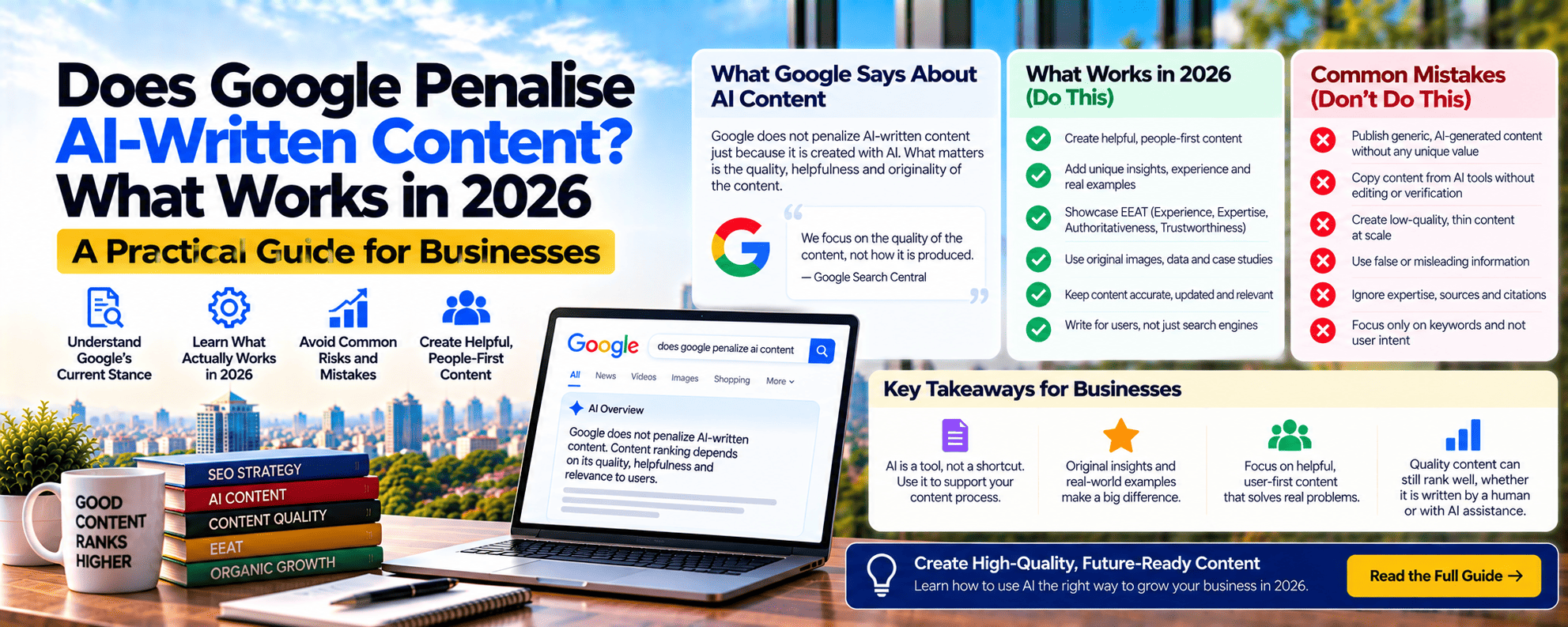
Does Google Penalize AI-Written Content? What Works in 2026
Does Google penalize AI content? The short answer is no, not just for being written with AI. Google has clearly said it rewards helpful, high-quality content, however it’s produced. But Google does penalize content made mainly to manipulate rankings, especially low-quality pages published at scale, and much careless AI content falls into exactly that category.
So the real question isn’t “AI or human?” It’s “Is this content genuinely useful, accurate, and original?” This guide explains what Google actually says, what gets websites hurt, and 7 practical rules for using AI safely in your SEO content in 2026.
What Google Officially Says About AI Content
In its guidance on AI-generated content in Google Search, Google explains that:
- It focuses on the quality of content, not how it was produced
- Using AI to create helpful content isn’t against its guidelines
- Using automation, including AI, mainly to manipulate search rankings is a violation of its spam policies
In simple words: Google cares about why and how well content is made, not who or what typed it.
What Actually Gets Websites Penalized
While Google doesn’t penalize AI itself, these practices can get sites demoted or even removed from results:
1. Scaled Content Abuse
Google’s spam policies target publishing many pages mainly to rank, with little value for users, whether they’re created by AI, humans, or both.
Example: A company publishes 300 AI pages like “Best Plumber in Koramangala,” “Best Plumber in HSR Layout,” and so on, where only the area name changes.
2. Doorway Pages
Pages created only to rank for similar searches and funnel users elsewhere, with no unique value on each page.
3. Thin, Unoriginal Content
Content that just rewrites what’s already on 10 other websites, with no new facts, experience, or insight.
4. Factual Errors and Made-Up Information
AI tools can confidently state wrong prices, fake statistics, or incorrect laws. For health, finance, and legal topics, this seriously damages trust.
5. Fake Authors and Fake Expertise
Invented author names, fake credentials, or “doctor-reviewed” claims with no real doctor.
Google’s 2024 crackdown: In March 2024, Google updated its core ranking systems and spam policies to target low-quality, unoriginal content. It later said these changes reduced such content in search results by about 45%.
Does Google Penalize AI Content That’s Well Edited?
No. Well-edited, fact-checked, experience-rich content that uses AI for research, outlines, or drafting can rank just as well as fully human-written content. Many successful websites use AI this way.
| Safe Use of AI | Risky Use of AI |
|---|---|
| Research and topic ideas | Publishing raw AI drafts |
| Outlines and content briefs | Hundreds of near-identical pages |
| First drafts, heavily edited by experts | No fact-checking |
| Summarising your own data | Invented statistics or quotes |
| FAQs based on real customer questions | Fake authors or reviews |
| Rewriting for clarity and simple English | Copying and “spinning” competitor content |
7 Rules to Use AI Content Safely in 2026
Rule 1: Let Humans Lead, and AI Assist
Start every piece with a human decision: who is this for, what problem does it solve, and what do we know that others don’t? Use AI to speed up research and drafting, not to decide what’s valuable.
Rule 2: Add First-Hand Experience
Google’s guidance on creating helpful content highlights experience and expertise. AI can’t add your real experience, so you must.
Add:
- Photos from your projects, clinic, or office
- Real prices from your quotes
- Case studies with actual numbers
- Lessons and mistakes from your work
Example: An AI draft on “modular kitchen cost in Bangalore” gives generic ranges. An interior firm adds: “In our last 40 projects in South Bangalore, the average L-shaped kitchen cost ₹2.4 lakh and took 32 days.” That line alone makes the page more valuable than 100 generic pages.
Rule 3: Fact-Check Everything
Check every price, statistic, date, law, and medical or financial claim. If you can’t verify it, remove it.
High-risk topics (extra care needed): Health, finance, legal, tax, and safety. Google holds these to higher standards because mistakes can harm people.
Rule 4: Edit for Voice, Clarity, and Local Relevance
Raw AI writing often sounds generic, with phrases like “in today’s fast-paced digital world.” Edit to:
- Use your brand’s voice
- Remove filler and repetition
- Add local context (areas, languages, Indian rupee prices)
- Use simple English your customers understand
Rule 5: Never Scale Thin Pages
Area pages and service pages are fine if each one has unique value. Each area page should include:
- Real projects or customers in that area
- Area-specific details (travel time, local landmarks, local prices)
- Unique photos and reviews
If you can’t add unique value to a page, don’t publish it.
Rule 6: Show Real Authors and Review Processes
- Add real author names with short bios
- Show qualifications where relevant (“Reviewed by Dr. Priya, BDS, 12 years’ experience”)
- Link to your About and Team pages
- Be open about your process if readers would reasonably want to know how content was made
Rule 7: Measure, Update, and Remove Weak Content
Publishing is not the end. Every 3–6 months:
- Update pages with new prices and information
- Improve pages with low engagement
- Merge or remove thin pages that bring no traffic
A Safe AI Content Workflow
| Step | Who Does It | AI’s Role |
|---|---|---|
| 1. Topic and keyword research | SEO specialist | Suggests ideas and clusters |
| 2. Content brief | SEO specialist | Drafts outline and questions |
| 3. First draft | Writer + AI | Creates a draft to edit |
| 4. Add experience and data | Subject expert | None (human only) |
| 5. Fact-check | Editor | None (human only) |
| 6. Edit for voice and clarity | Editor | Suggests simpler wording |
| 7. SEO optimisation | SEO specialist | Checks structure and gaps |
| 8. Publish and track | SEO specialist | Helps analyse data |
This workflow gives you the speed of AI with the quality Google rewards.
Signs AI Content May Be Hurting Your Site
Check these in Google Search Console:
| Warning Sign | Where to Check |
|---|---|
| A manual action for spam or thin content | Security & Manual Actions |
| Sudden traffic drop after a Google core update | Performance report |
| Many pages “Crawled – currently not indexed” | Pages (Indexing) report |
| Very low engagement on blog pages | GA4 engagement rate |
| Rankings for keywords with no clicks or leads | Performance + GA4 |
How to Recover If Your Site Is Affected
- Audit all AI-heavy pages: List pages with low traffic, low engagement, or thin content.
- Improve or remove: Rewrite the valuable ones with expertise and data. Merge duplicates. Remove pages with no value.
- Fix factual errors: Correct prices, statistics, and claims.
- Add author and trust signals: Real bios, reviews, and case studies.
- For manual actions: Fix the issues, then submit a reconsideration request in Search Console.
- Be patient: Recovery after core updates often takes months, and usually shows after the next update.
If you’re worried an SEO provider is mass-producing low-quality content for you, read our guide on SEO company red flags.
Myths About AI Content and Google
“Google uses AI detectors to find and penalize AI content.”
Google’s focus is on quality and spam behaviour, not whether a detector labels text as AI. Don’t rely on detector scores. Rely on usefulness and accuracy.
“Adding a human touch means changing a few words.”
No. Real value comes from experience, data, and expertise, not light rewording.
“More content always means more traffic.”
No. 20 excellent pages often outperform 200 weak ones.
“AI content can’t rank.”
It can, when it’s edited, accurate, and genuinely helpful.
Metrics to Track Content Quality
| Metric | Where to Check | Healthy Target |
|---|---|---|
| Indexed pages vs published | Search Console → Pages | 90%+ indexed |
| Engagement rate | GA4 | 50%+ for blog pages |
| Average engagement time | GA4 | 1.5–3 minutes |
| Pages with zero clicks (90 days) | Search Console | Under 20% of content |
| Organic leads from content | GA4 conversions | Rising month on month |
| Manual actions | Search Console | Zero |
ROI example: A training institute replaces 60 thin AI blogs with 15 expert-reviewed guides. Within 6 months, organic traffic rises 70% and course enquiries from blog pages grow from 8 to 30 a month. At 5 admissions a month worth ₹20,000 each, that’s ₹1 lakh in monthly revenue from better content, not more content.
How Beta Digital Marketing Uses AI in Content
At Beta Digital Marketing, we’re an AI-first agency, but never AI-only:
- AI for speed: Research, clustering, outlines, and first drafts
- Humans for quality: Expert editing, fact-checking, and local insights
- Real experience: Case studies, real prices, and client results in every key page
- No scaled spam: Every page must add unique value
- Regular content audits: We update, merge, or remove weak pages
Our SEO plans start from ₹12,000/month. Explore our SEO services, or read our guides on AI SEO vs traditional SEO and how long SEO takes.
Frequently Asked Questions
Does Google penalize AI content?
Not just for being AI-written. Google penalizes low-quality content made mainly to manipulate rankings, such as mass-produced thin pages, whether it’s written by AI or humans.
Can AI-written blogs rank on Google?
Yes, if they’re edited, fact-checked, genuinely helpful, and include real experience or expertise.
What is scaled content abuse?
Publishing large numbers of pages mainly to rank in search, with little value for users. It’s against Google’s spam policies, regardless of how the content is made.
Should I tell readers that I used AI?
Google suggests being open about how content was made where readers would reasonably expect it. At minimum, show who wrote and reviewed the content.
How do I know if AI content is hurting my site?
Check Search Console for manual actions, sudden traffic drops after core updates, and pages not being indexed. Also check engagement in GA4.
Get a Free Content Quality Audit
Worried your AI content might be holding back your rankings? Get a free content quality audit from Beta Digital Marketing. We’ll review your pages, find thin or risky content, and show you what to improve, merge, or remove.
📞 +91 95139 99901 | ✉️ hello@betadigitalmarketing.com | Book your free content audit →