- Written by: admin
- May 9, 2026
Introduction
Bangalore, officially known as Bengaluru, is one of India’s most important political, business, technology, and youth-driven cities. The Government of Karnataka’s Bengaluru Urban district history page notes that Bengalūru was declared the official name of the city and also highlights the city’s identity as the “Silicon Valley of India” because of its role in the IT sector. In such a digitally active city, political communication can no longer depend only on rallies, banners, newspaper ads, and door-to-door visits. Today, voters search online, follow local news on social media, watch short videos, join WhatsApp groups, discuss civic issues on X, Instagram, Facebook, and YouTube, and expect political leaders to respond quickly.
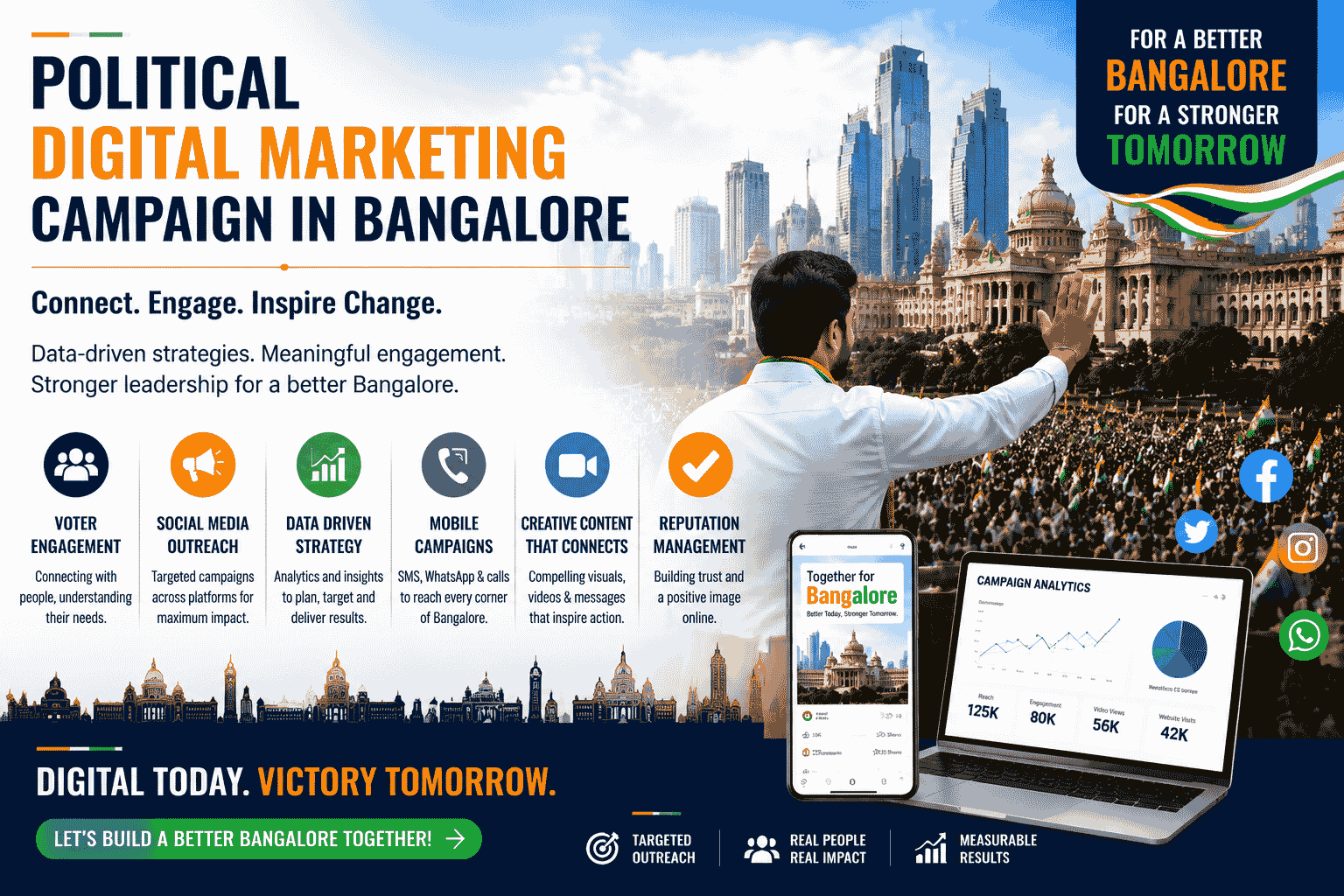
A well-planned political digital marketing campaign in Bangalore helps political leaders, parties, candidates, and public representatives connect with voters in a professional, ethical, and measurable way. It is not only about posting photos or running ads. A strong campaign includes voter awareness content, local issue communication, social media management, search visibility, reputation building, video storytelling, multilingual messaging, crisis response, volunteer coordination, and compliance with Election Commission rules.
India’s digital audience is massive. TRAI reported that India had more than 1.02 billion internet subscribers by the end of December 2025, showing how important online communication has become for public outreach. DataReportal’s Digital 2026 India report also notes that there were 455 million social media user identities aged 18 and above in India at the end of 2025. For a city like Bangalore, where many voters are mobile-first, educated, multilingual, and issue-aware, digital campaigning is now a core part of political success.
Why Political Digital Marketing Matters in Bangalore
Bangalore is not a simple one-message city. It has IT professionals, startup founders, students, senior citizens, apartment communities, traders, auto drivers, civic activists, migrant workers, government employees, and traditional local communities. Voters in areas like Whitefield, Koramangala, Jayanagar, Hebbal, Yelahanka, Mahadevapura, Rajajinagar, Malleshwaram, KR Puram, Electronic City, Shivajinagar, Basavanagudi, and Bommanahalli may care about different issues. Some focus on traffic, potholes, metro connectivity, water supply, lake protection, garbage management, property tax, safety, employment, housing, or local governance.
This is why political digital marketing in Bangalore must be hyper-local. A generic campaign message may not work for every ward or constituency. A candidate must understand what people are discussing in each area and create content that answers those concerns clearly. Digital platforms help campaigns listen, respond, and build trust before election day.
Traditional campaigning creates visibility, but digital marketing creates continuous engagement. A voter may see a rally once, but they may see a candidate’s work every day through Instagram reels, YouTube videos, Facebook posts, WhatsApp updates, Google search results, news articles, and local community groups. When digital content is consistent and authentic, it builds familiarity. Familiarity builds trust. Trust influences public perception.
Key Elements of a Successful Political Digital Marketing Campaign
A successful political campaign in Bangalore needs a complete digital ecosystem. Every platform should support the same message, but the content style should change according to the audience and channel.
1. Strong Political Brand Positioning
Before starting social media posts or ads, the candidate must have clear positioning. What does the leader stand for? Development? Clean governance? Youth empowerment? Better infrastructure? Local issue solving? Public accessibility? Transparency?
Political branding includes the candidate’s message, tone, visual identity, slogan, biography, achievements, promises, and public image. In Bangalore, where voters often compare leaders based on performance and credibility, a strong personal brand is very important. The campaign should highlight the candidate’s work, values, experience, and connection with local people.
A good political brand should be simple, memorable, and believable. Voters should easily understand who the candidate is, what they support, and why they are different from others.
2. Social Media Management for Politicians
Social media is the heart of modern political digital marketing. Platforms like Facebook, Instagram, X, YouTube, LinkedIn, and WhatsApp help candidates communicate directly with voters. However, every platform requires a different content strategy.
Instagram is useful for reels, short videos, youth engagement, behind-the-scenes content, and visual storytelling. Facebook works well for local community updates, live sessions, event photos, and longer posts. X is important for quick reactions, political statements, media visibility, and issue-based communication. YouTube is ideal for speeches, interviews, campaign films, testimonials, and issue explainers. LinkedIn can be useful for professional audiences, policy-focused communication, and development-oriented messaging.
For Bangalore, social media content should include ward visits, public meetings, civic issue updates, problem-solving videos, before-and-after development work, citizen testimonials, festival greetings, media coverage, and local language communication.
3. Multilingual Content Strategy
Bangalore is a multilingual city. Kannada is essential, but many voters also consume content in English, Hindi, Tamil, Telugu, Urdu, and Malayalam. A smart political digital marketing campaign in Bangalore should not depend on only one language.
Kannada content helps build local connection and cultural respect. English content reaches urban professionals, students, entrepreneurs, and apartment communities. Hindi and other regional languages can help communicate with migrant communities and mixed-language neighborhoods.
The key is not simple translation. The message should feel natural in every language. A Kannada post should sound like it belongs to local people. An English post should be clear, modern, and professional. A multilingual strategy helps campaigns expand reach without losing authenticity.
4. Local Issue-Based Content
Voters are more likely to engage with content that affects their daily life. In Bangalore, political digital content should focus on real local problems and solutions. Instead of only posting political slogans, campaigns should publish helpful and transparent updates.
Examples of strong local content include:
“Road repair work started in Ward X after resident complaints.”
“Water supply issue raised with concerned department.”
“Metro connectivity discussion with local citizens.”
“Lake cleaning drive with volunteers.”
“Traffic blackspot inspection with residents.”
“Public grievance meeting summary.”
“Monthly work report of the candidate.”
Issue-based content makes the campaign practical. It shows that the leader is not only asking for votes but is also listening, working, and reporting back to citizens.
5. Search Engine Optimization for Political Leaders
When voters search a candidate’s name on Google, what do they find? This is where SEO becomes important. Political SEO helps control and improve the online presence of a candidate, party office, campaign website, and public work.
A strong SEO strategy includes a candidate website, optimized biography, local landing pages, blog articles, press releases, Google Business Profile if relevant, news mentions, image optimization, video SEO, and reputation-friendly search results.
For example, a candidate can publish blogs on topics like “Development Work in Mahadevapura,” “Traffic Solutions for Bangalore East,” “Youth Employment Initiatives in Bengaluru,” or “How Local Governance Can Improve Ward Services.” These articles help the campaign appear in search results and educate voters.
SEO is especially useful in Bangalore because many voters research candidates online before forming an opinion. A well-optimized digital profile builds credibility and helps reduce the impact of misinformation.
Compliance and Ethical Political Digital Marketing
Political campaigns in India must follow Election Commission rules and the Model Code of Conduct when applicable. The Election Commission of India states that the Model Code of Conduct provides guidance for political parties and candidates on general conduct, meetings, processions, polling day, and related election behavior.
For digital campaigns, compliance is especially important. In 2026, PIB reported that political parties must get advertisements pre-certified by the Media Certification and Monitoring Committee, and candidates must share details of their authentic social media accounts. The ECI has also required that synthetically generated or AI-altered campaign content be clearly labelled as “AI-Generated,” “Digitally Enhanced,” or “Synthetic Content,” along with disclosure of the originating entity.
This means a professional political digital marketing campaign should maintain proper approval records, ad copies, invoices, spending details, platform reports, and content archives. It should avoid fake news, hate speech, misleading edits, impersonation, deepfakes without disclosure, communal messaging, and personal attacks that violate election rules.
Ethical campaigning is not just a legal requirement. It is also a trust-building strategy. Voters are becoming more aware of fake content and manipulation. A transparent campaign creates long-term credibility for the leader.
Paid Political Advertising
Paid ads can help a campaign reach more people quickly. Platforms like Google, YouTube, Facebook, and Instagram can be useful for awareness campaigns, event promotion, issue videos, manifesto highlights, and candidate introduction.
However, political advertising must be handled carefully. Campaigns should use approved creatives, proper disclaimers, verified accounts, and documented spending. The goal should be to inform voters, not mislead them.
In Bangalore, paid campaigns can be planned around location-based communication. For example, an issue video about traffic congestion can be promoted in areas where that issue is highly relevant. A Kannada video can be promoted to Kannada-speaking audiences, while English explainers can be used for professional communities. But campaigns should avoid unethical manipulation, false claims, or sensitive personal targeting.
WhatsApp and Community Outreach
WhatsApp is one of the strongest political communication tools in India. In Bangalore, apartment groups, resident welfare associations, local business groups, student networks, and volunteer groups often use WhatsApp for daily updates. A good campaign can use WhatsApp for event reminders, issue updates, volunteer coordination, booth-level communication, and quick response.
But WhatsApp must be used responsibly. Spamming voters can damage reputation. Forwarding unverified claims can create legal and public trust problems. A strong WhatsApp strategy should include verified messages, simple creatives, short videos, helpline numbers, local language updates, and clear source information.
Campaign teams should create official broadcast channels and verified community groups where possible. Every message should be short, useful, and respectful.
Video Marketing for Political Campaigns
Video is one of the most powerful formats for political communication. Voters may not read a long manifesto, but they may watch a 45-second reel or a 2-minute issue explainer. Video helps show emotion, leadership personality, public connection, and proof of work.
Strong political video content includes:
Candidate introduction videos
Public work documentaries
Citizen testimonial videos
Speech highlights
Festival and cultural greetings
Issue explanation videos
Myth-busting videos
Volunteer stories
Day-in-the-campaign videos
Local development updates
In Bangalore, short videos should be created in Kannada and English at minimum. Subtitles are important because many users watch videos without sound. The first three seconds should be strong, and the message should be clear.
Online Reputation Management for Politicians
Reputation can change quickly in politics. One viral post, negative article, edited video, or rumor can affect public image. Online reputation management helps monitor, respond, and protect the candidate’s credibility.
ORM includes social listening, Google search monitoring, review of news mentions, comment moderation, misinformation tracking, crisis response, and positive content publishing. The goal is not to hide criticism. The goal is to respond with facts, clarity, and professionalism.
For Bangalore politicians, reputation management should be active every day, not only during elections. A leader who regularly posts work updates, citizen interactions, and transparent explanations will be more resilient during negative campaigns.
Data and Analytics in Political Digital Marketing
Digital marketing allows campaigns to measure performance. Instead of guessing, teams can track what content is working. Important metrics include reach, engagement, video views, watch time, website traffic, search rankings, follower growth, sentiment, ad performance, volunteer sign-ups, event registrations, and issue-wise response.
Analytics help campaigns improve. If a video about water issues performs well in one area, the campaign can create more content on that topic. If English posts perform better among professionals, the team can create policy explainers. If Kannada reels get high engagement, the team can increase local storytelling.
Data should be used to improve communication and service, not to manipulate voters. Ethical data handling is essential for political credibility.
Suggested 90-Day Political Digital Campaign Plan
A strong campaign can be planned in phases.
Phase 1: Research and Digital Setup
The first 15 days should focus on research, competitor analysis, voter issue mapping, social media audit, website setup, branding, content calendar, photography, video templates, and compliance planning.
Phase 2: Awareness Building
From day 16 to day 45, the campaign should focus on candidate introduction, local issue content, public work highlights, biography videos, community meetings, and regular social media posting. SEO blogs and press releases should also begin during this phase.
Phase 3: Engagement and Trust Building
From day 46 to day 75, the campaign should increase two-way communication. This includes live sessions, citizen feedback forms, WhatsApp groups, volunteer drives, local testimonials, and issue-based videos.
Phase 4: Conversion and Mobilization
From day 76 to day 90, the campaign should focus on reminders, booth-level communication, event promotion, pledge campaigns, voter awareness, and clear calls to action. During election periods, all activities must follow applicable ECI rules, silence period restrictions, and advertising approvals.
Best Content Ideas for Political Campaigns in Bangalore
A political digital marketing campaign in Bangalore should not post randomly. The campaign needs a structured content calendar. Here are powerful content themes:
Daily public work updates
Weekly “citizen problem solved” posts
Monthly report card
Local area development videos
Youth-focused policy explainers
Women safety awareness content
Senior citizen support posts
Traffic and infrastructure issue explainers
Festival greetings with local culture
Kannada pride and Bengaluru identity content
Volunteer appreciation posts
Media coverage highlights
Live Q&A sessions
Myth vs fact posts
Booth-level voter awareness creatives
The best content is simple, visual, local, and consistent.
Why Hire a Political Digital Marketing Agency in Bangalore?
Running a political digital campaign requires many skills. A candidate needs strategists, content writers, designers, video editors, social media managers, ad experts, SEO specialists, photographers, data analysts, and reputation managers. A professional political digital marketing agency in Bangalore can bring all these services under one plan.
An agency helps maintain consistency, speed, quality, and compliance. It can create daily content, monitor public response, manage ads, prepare speeches, write press notes, design posters, produce videos, and track campaign performance.
Most importantly, an experienced agency understands local political culture, voter psychology, Bangalore civic issues, and multilingual communication. This makes the campaign more relevant and effective.
Conclusion
A successful political digital marketing campaign in Bangalore is not about noise. It is about trust, clarity, consistency, and connection. Bangalore voters are digitally active, issue-aware, and quick to judge authenticity. They expect political leaders to be visible, responsive, and transparent.
The right digital campaign can help a candidate build a strong public image, communicate achievements, address local issues, reach multilingual voters, manage reputation, and create meaningful engagement. But the campaign must be ethical, compliant, and focused on real public service.
In today’s Bangalore, political success depends on both ground presence and digital presence. A leader who combines local work with smart online communication can build stronger voter trust and long-term public support.
An agency helps maintain consistency, speed, quality, and compliance. It can create daily content, monitor public response, manage ads, prepare speeches, write press notes, design posters, produce videos, and track campaign performance.
Most importantly, an experienced agency understands local political culture, voter psychology, Bangalore civic issues, and multilingual communication. This makes the campaign more relevant and effective.