- Written by: admin
- September 29, 2026
What Is Generative Engine Optimization (GEO)? A Simple Guide for Indian Businesses
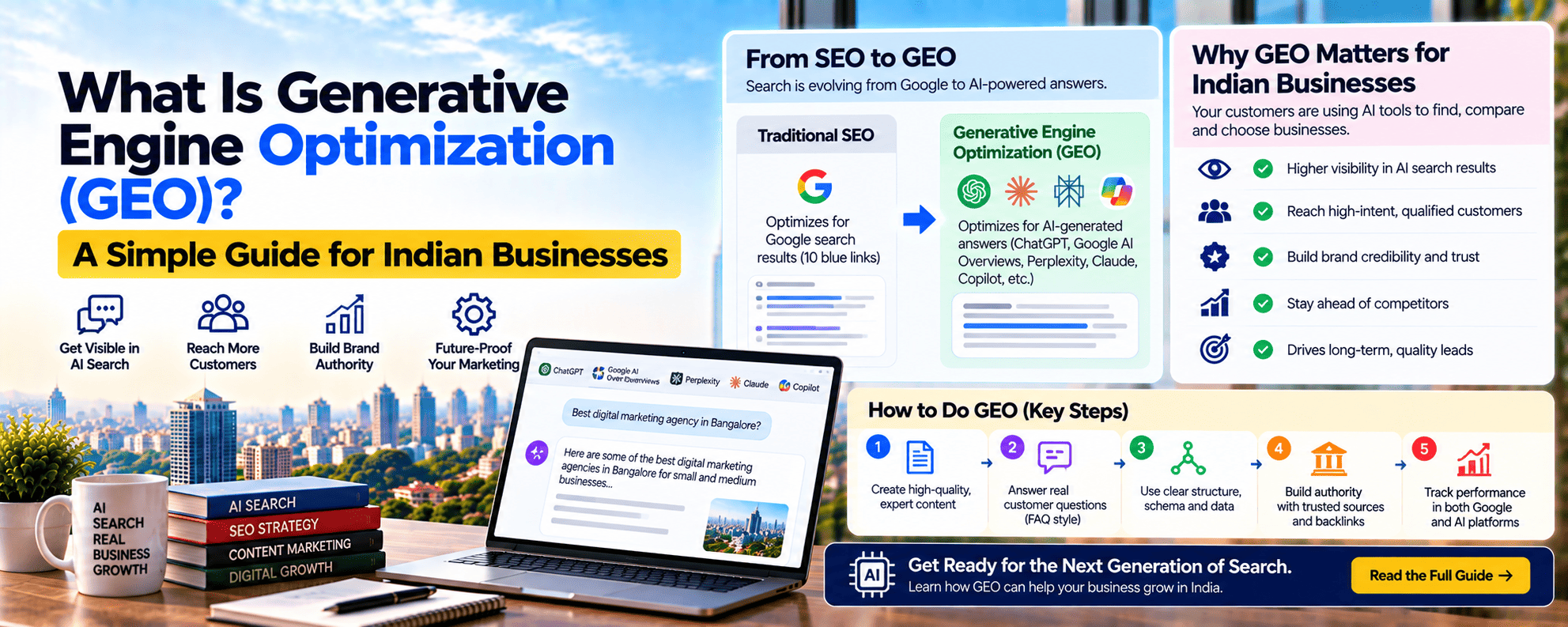
What is generative engine optimization? Generative Engine Optimization (GEO) is the process of making your business appear in answers created by AI tools like ChatGPT, Google Gemini, Perplexity, Claude, and Google AI Overviews. Traditional SEO helps you rank in Google’s list of links. GEO helps you get mentioned, recommended, and cited when AI gives a direct answer.
Here’s why it matters. A customer in Bangalore used to search “best physiotherapist in HSR Layout” and click through 5 websites. Today, many people ask ChatGPT or read Google’s AI Overview, and get 3 names instantly. If your business isn’t one of those names, you lose the customer without ever knowing they searched.
This guide explains GEO in simple words, how AI tools choose which businesses to mention, and 8 practical steps Indian businesses can take to start appearing in AI answers.
Where Did GEO Come From?
The term “Generative Engine Optimization” was introduced in a 2023 research paper by researchers from Princeton and other institutions (read the GEO research paper). They found that certain content changes, such as adding citations, quotes, and statistics, could noticeably improve how often a source appears in AI-generated answers. In their tests, visibility improved by up to around 40%.
Since then, GEO has become one of the fastest-growing areas of digital marketing.
GEO vs SEO vs AEO: What’s the Difference?
| SEO | AEO | GEO | |
|---|---|---|---|
| Full form | Search Engine Optimization | Answer Engine Optimization | Generative Engine Optimization |
| Goal | Rank in Google’s links | Become the direct answer (snippets, voice) | Get mentioned in AI-generated answers |
| Where | Google, Bing results | Featured snippets, voice assistants, AI Overviews | ChatGPT, Gemini, Perplexity, Claude, AI Overviews |
| Success looks like | Position #1–10 | Your answer shown on top | Your brand named or cited by AI |
| Main levers | Keywords, links, technical SEO | Clear Q&A content, schema | Authority, mentions, clear facts, structured content |
Important: GEO doesn’t replace SEO. AI tools often pull information from websites that already rank well and are trusted. Good SEO is the foundation, and GEO builds on top of it.
Why GEO Matters for Indian Businesses
- Customer behaviour is changing: More Indians use ChatGPT, Gemini, and Google AI Overviews for research, especially for services, courses, and B2B products.
- Fewer clicks: When AI answers the question directly, fewer people click website links.
- Early advantage: Most Indian SMEs haven’t started GEO yet. Businesses that start now can build visibility before competitors catch up.
- Trust factor: When AI recommends your business, customers see it as a neutral, trusted suggestion.
Example: An IT training institute in Marathahalli asks ChatGPT “best AWS training institute in Bangalore.” Three competitors are named, but they aren’t. Their Google rankings are decent, but they have few reviews, no FAQ content, and inconsistent business details online. That’s a GEO gap.
How Do AI Tools Decide Which Businesses to Mention?
Understanding what generative engine optimization targets means understanding how AI picks sources. While each tool works differently, they commonly rely on:
- Trusted websites: Pages that already rank well and are seen as reliable
- Clear, direct answers: Content that answers questions simply and early
- Consistent business information: The same name, address, services, and details across the web
- Mentions on other sites: Reviews, directories, news, Reddit, Quora, and industry sites
- Structured data: Schema markup that helps machines understand your content
- Fresh, factual content: Recent updates, real numbers, and specific details
- Crawler access: AI bots must be allowed to read your website
Google explains how its AI features use website content in its guide on AI features and your website.
8 Steps to Start Generative Engine Optimization
Step 1: Check Your Current AI Visibility
List 20 questions your customers ask, for example:
- “Best interior designer in JP Nagar”
- “How much does root canal cost in Bangalore”
- “Top CNC machine manufacturers in Peenya”
Ask each one in ChatGPT, Gemini, and Perplexity. Note whether your brand appears, which competitors appear, and which websites are cited. This is your baseline.
Step 2: Allow AI Crawlers and Add llms.txt
Check your robots.txt file. Make sure you’re not accidentally blocking AI crawlers such as OpenAI’s GPTBot (OpenAI’s crawler documentation), PerplexityBot, and Google-Extended.
A simple example:
User-agent: GPTBot
Allow: /

User-agent: PerplexityBot
Allow: /
Also consider adding an llms.txt file. It’s a simple text file that summarises your business and key pages for AI tools. It’s still an emerging standard, but it’s quick to add.
Step 3: Write Answer-First Content
AI tools prefer content that answers the question in the first 2–3 sentences.
Weak: “Welcome to our clinic. We have been serving patients for many years…”
Strong: “Root canal treatment in Bangalore costs ₹4,000–₹12,000 per tooth, depending on the tooth and material. At our Jayanagar clinic, most treatments take 1–2 visits.”
Add an FAQ section to every service page, answering real customer questions.
Step 4: Add Schema Markup
Use Schema.org structured data such as:
- Organization or LocalBusiness (name, address, phone, hours)
- Service (what you offer)
- FAQPage (your FAQ sections)
- Review or AggregateRating (where allowed)
Schema helps AI tools understand exactly who you are and what you do.
Step 5: Make Your Business Details Consistent Everywhere
Your business name, address, phone, and services should match across:
- Your website
- Google Business Profile
- Justdial, Sulekha, IndiaMART
- LinkedIn company page
- Facebook and Instagram
- Industry directories
Inconsistent details confuse AI tools and reduce trust.
Step 6: Build Mentions and Reviews
AI tools often trust brands that other people talk about. Focus on:
- Google reviews: Aim for 5–10 new reviews a month
- Review platforms: Clutch, GoodFirms, Justdial, and industry-specific sites
- Community answers: Helpful, honest answers on Quora and relevant Reddit threads
- Local media and industry blogs: Guest articles, interviews, and features
- LinkedIn: Regular expert posts from founders and team members
Step 7: Add Facts, Numbers, and Expert Insights
Based on the GEO research, content with statistics, quotes, and sources tends to get cited more often. Add:
- Real pricing ranges
- Your own data (for example, “average project time: 45 days”)
- Quotes from your doctors, engineers, or founders
- Case studies with before-and-after numbers
Step 8: Keep Content Fresh
Update key pages every 3–6 months. Change the year, refresh prices, and add new FAQs. AI tools and Google both prefer current information.
GEO for Local Businesses in India
For clinics, salons, coaching centres, and service businesses, GEO starts with local basics:
| Action | Why It Helps |
|---|---|
| Complete Google Business Profile | AI tools often use it for local answers |
| 50+ genuine Google reviews | Builds trust and recommendation signals |
| Area pages (e.g., “Dentist in JP Nagar”) | Matches how people ask AI questions |
| FAQ with prices and timings | Gives AI clear facts to quote |
| Consistent Justdial and Sulekha listings | Confirms your details across sources |
Common GEO Myths
Myth 1: “GEO replaces SEO.”
No. GEO works best on top of strong SEO.
Myth 2: “You can pay to appear in ChatGPT answers.”
You can’t pay for organic AI answers. You earn them through authority and clear content.
Myth 3: “GEO is only for big brands.”
Local businesses can often win AI answers faster, because local competition is smaller.
Myth 4: “Results are instant.”
Technical fixes are quick, but building mentions and authority takes 3–6 months.
How to Measure GEO Results
| Metric | How to Track | Healthy Target |
|---|---|---|
| AI mention rate | % of your 20 tracked questions where your brand appears | Rising monthly; 20–40% by month 6 |
| AI referral traffic | GA4 → sessions from chatgpt.com, perplexity.ai, gemini.google.com | Growing month on month |
| Google AI Overview appearances | Manual checks for key queries | Appearing for 5–10+ queries |
| Branded searches | Google Search Console | 15–30% growth in 6 months |
| Leads from AI referrals | GA4 conversion events | Tracked and rising |
| Share of voice vs competitors | Your mentions ÷ total mentions across tracked questions | Improving every quarter |
Free tracking method: Create a Google Sheet with your 20 questions. Every month, test them in ChatGPT, Gemini, and Perplexity. Mark ✅ if you’re mentioned and note which competitors appear. It takes about an hour and costs nothing.
ROI example: A coaching centre starts GEO in January. By June, it gets 25 leads a month from AI referrals and branded searches. If 4 students join at ₹20,000 each, that’s ₹80,000 a month. At ₹15,000/month for GEO work:
ROI = (80,000 − 15,000) ÷ 15,000 × 100 = 433%.
How Much Does GEO Cost in India?
GEO is often offered as an add-on to SEO for ₹8,000–₹15,000 a month, or as a full AI SEO package from ₹15,000 to ₹1,50,000+. For a full breakdown, read our guide on AI SEO pricing in India.
How Beta Digital Marketing Helps With GEO
At Beta Digital Marketing, we use generative engine optimization on our own website first, including llms.txt, Organization schema, and answer-focused content. Then we apply it for clients.
Our GEO service includes:
- AI visibility audit across ChatGPT, Gemini, and Perplexity
- AI crawler setup, llms.txt, and schema markup
- Answer-first content and FAQ optimization
- Brand mention and review strategy
- Monthly AI visibility reports with mention rate and AI referral traffic
GEO is part of our SEO plans, starting from ₹12,000 a month. See how we help businesses that are invisible on ChatGPT and AI search, or explore our AI SEO agency services in Bangalore. You may also like our guide on how long SEO takes.
Frequently Asked Questions
What is generative engine optimization in simple words?
It’s the process of making your business appear in answers from AI tools like ChatGPT, Gemini, Perplexity, and Google AI Overviews.
Is GEO different from SEO?
Yes. SEO focuses on ranking in search results. GEO focuses on getting mentioned and cited in AI-generated answers. Both work together.
Can small businesses in India benefit from GEO?
Yes. Local businesses often see faster results because there’s less competition in local AI answers.
How long does GEO take to work?
Usually 3–6 months. Technical fixes are quick, but building mentions and authority takes time.
How do I check if ChatGPT mentions my business?
Ask ChatGPT, Gemini, and Perplexity the questions your customers ask, and note whether your brand appears. Repeat monthly to track progress.
Get a Free AI Visibility Audit
Want to know if ChatGPT, Gemini, and Google AI mention your business? Get a free AI visibility audit from Beta Digital Marketing. We’ll test your brand on 20 customer questions, compare you with competitors, and show you exactly what to fix.
📞 +91 95139 99901 | ✉️ hello@betadigitalmarketing.com | Book your free AI audit →