- Written by: admin
- May 9, 2026
Introduction
Digital Marketing for Political Campaigns in India has become one of the most powerful ways for politicians, election candidates, political parties, and campaign managers to connect with voters, build trust, and communicate their message clearly. In today’s digital world, voters do not depend only on rallies, banners, posters, newspapers, or television news. They use Google, Facebook, Instagram, YouTube, X, WhatsApp, online news portals, and regional digital platforms to learn about leaders, parties, promises, achievements, and public issues.
A strong political campaign now needs both ground-level work and digital communication. Door-to-door campaigning, public meetings, local events, and party workers are still important, but digital platforms help campaigns reach people faster and more consistently. A single video, post, speech clip, or WhatsApp message can reach thousands of people within a short time. This is why Digital Marketing for Political Campaigns in India is now a necessary part of modern political strategy.
A professional political digital marketing campaign helps leaders build a positive image, promote development work, manage public perception, share campaign promises, respond to misinformation, and connect with voters in local languages. The goal is not only to gain likes, followers, or views. The real goal is to create credibility, trust, awareness, and long-term connection with the public.
Why Digital Marketing Is Important for Political Campaigns in India
India is a large and diverse democracy with many languages, regions, communities, cultures, and political issues. A campaign message that works in one state may not work in another. Voters in urban areas may focus on employment, traffic, infrastructure, education, healthcare, and safety. Voters in rural areas may focus on agriculture, water, roads, electricity, welfare schemes, and local development.
Digital marketing helps political campaigns create customized communication for different audiences. It allows leaders to speak directly to voters in their preferred language and platform. A candidate can share daily updates, respond to public concerns, promote events, explain policies, and highlight achievements.
Digital marketing helps political campaigns:
Build public trust
Improve online visibility
Reach youth and first-time voters
Share development work
Promote rallies and meetings
Communicate manifesto points
Manage online reputation
Respond to fake news and misinformation
Improve Google search presence
Create regional language campaigns
Strengthen candidate branding
Track campaign performance
A politician who is active online appears more accessible and modern. Regular digital communication helps voters understand the leader’s work, personality, and vision.
What Is Digital Marketing for Political Campaigns?
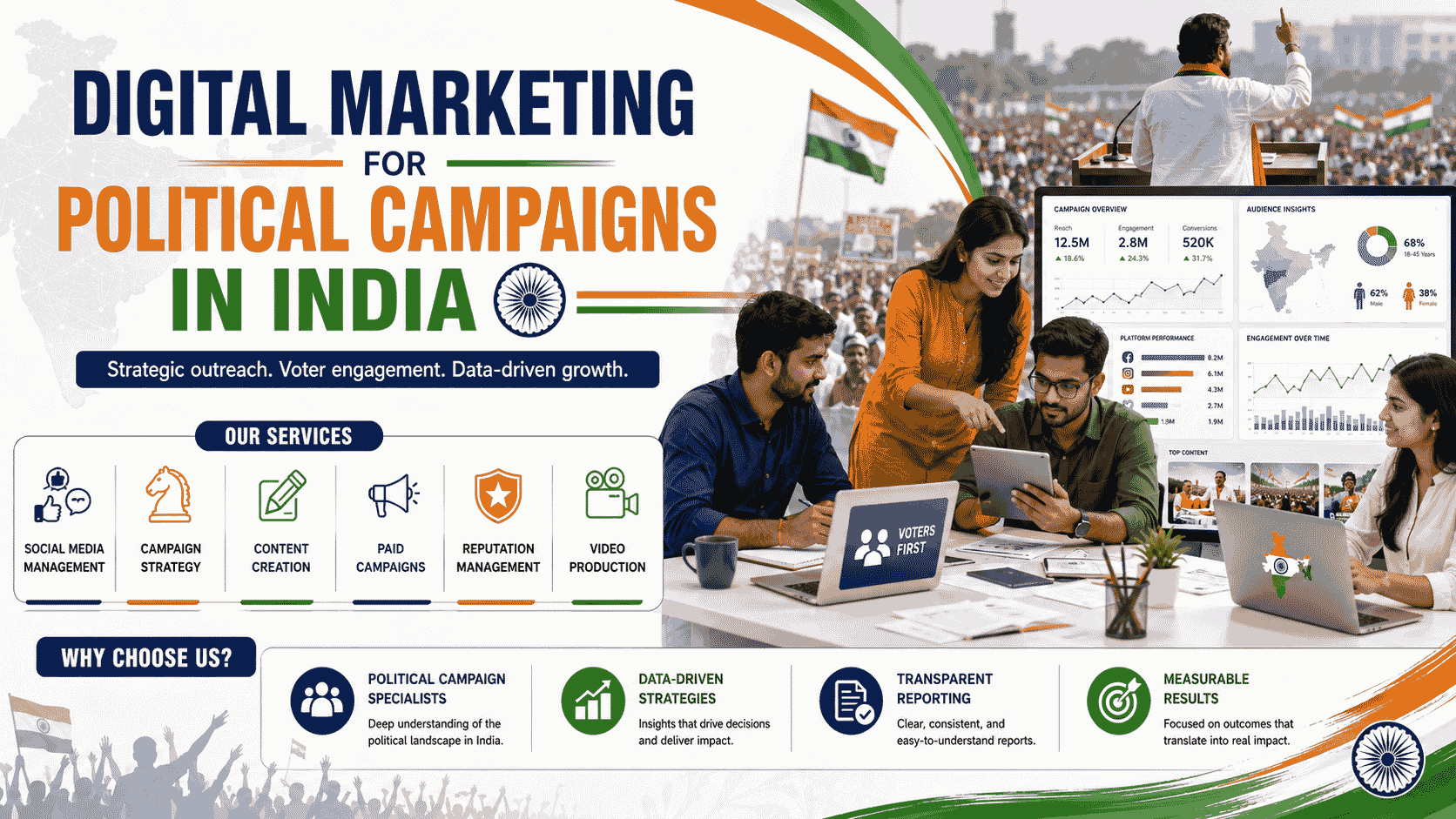
Digital Marketing for Political Campaigns in India means using online platforms and digital tools to promote a political leader, party, campaign message, or election strategy. It includes social media management, SEO, website development, content writing, video marketing, WhatsApp outreach, online advertising, public relations, reputation management, and data analytics.
A successful political digital campaign is not random posting. It requires a clear plan, strong message, consistent branding, local issue-based content, and ethical communication.
The main services in political digital marketing include:
Political campaign strategy
Candidate branding
Social media marketing
Political SEO
Website development
Video production
Graphic design
Content writing
WhatsApp campaign management
Paid digital advertising
Online reputation management
Press release writing
Public relations
Crisis communication
Data analytics and reporting
A professional digital marketing team helps political leaders communicate the right message to the right audience at the right time.
Political Branding for Candidates and Parties
Political branding is the foundation of a successful campaign. Every politician or party needs a clear identity that voters can easily understand and remember. Political branding is not only about a logo or color. It is about the leader’s image, message, values, promises, personality, and connection with people.
A strong political brand answers important questions:
Who is the leader?
What does the leader stand for?
What problems will the leader solve?
Why should voters trust this candidate?
What is the leader’s vision for the constituency?
What makes this campaign different?
For example, one candidate may focus on youth development. Another may focus on infrastructure, women’s safety, farmer welfare, education, healthcare, employment, clean governance, or local problem-solving.
A strong political brand includes:
Candidate biography
Campaign slogan
Vision and mission
Design theme
Profile photography
Leadership message
Public service story
Achievements
Local connection
Tone of communication
A digital marketing agency helps create this identity and maintain it across social media, websites, videos, posters, press releases, and advertisements.
Social Media Marketing for Political Campaigns
Social media is one of the most important parts of political digital marketing. It gives politicians a direct way to communicate with voters without depending only on traditional media.
Platforms like Facebook, Instagram, YouTube, X, LinkedIn, and WhatsApp are useful for political campaigns. Each platform has a different role.
Facebook is useful for public meeting updates, community engagement, long posts, live videos, event promotion, and local discussions. Instagram is useful for reels, short videos, campaign highlights, youth engagement, and visual storytelling. YouTube is useful for speeches, interviews, documentaries, campaign films, and issue-based videos. X is useful for political statements, quick updates, media reactions, and trending conversations. WhatsApp is useful for direct communication, volunteer coordination, and booth-level campaign updates.
A good social media campaign includes:
Daily posts
Short videos
Reels
Candidate speeches
Public meeting photos
Development work updates
Citizen testimonials
Festival greetings
Volunteer stories
Press coverage
Manifesto highlights
Issue-based posts
Live sessions
Myth vs fact posts
Campaign announcements
A strong social media strategy keeps the campaign active, professional, and visible.
SEO for Political Campaigns in India
SEO means Search Engine Optimization. It helps political leaders and parties appear on Google when voters search for their name, party, constituency, achievements, campaign promises, or political services.
Google search results are very important in politics. If voters search for a candidate and find positive, official, and useful information, it improves trust. If they find negative, outdated, or confusing information, it can affect public image.
Political SEO includes:
Candidate website optimization
SEO-friendly biography
Blog writing
Local keyword targeting
Image optimization
Video SEO
Press release optimization
Google search reputation management
Positive article publishing
Constituency-based content
Search result monitoring
Useful political SEO keywords include:
Digital Marketing for Political Campaigns in India
political digital marketing agency in India
political campaign agency in India
digital marketing for politicians
election campaign digital marketing
political SEO services
social media marketing for politicians
online reputation management for politicians
SEO helps political campaigns build long-term digital authority. Unlike paid ads, SEO content can continue bringing visibility even after the campaign period.
Website Development for Political Campaigns
Every serious political campaign should have an official website. Social media pages are important, but a website gives full control over information, branding, and communication.
A political campaign website can include:
Candidate biography
Vision and mission
Campaign promises
Development work
Photo gallery
Video gallery
News and media coverage
Upcoming events
Volunteer registration form
Contact form
Public grievance form
Speeches and articles
Manifesto or policy documents
Constituency updates
A website helps voters, journalists, supporters, volunteers, and party workers find accurate information in one place. It also improves Google visibility and builds professionalism.
A good political website should be mobile-friendly, fast-loading, secure, easy to navigate, and SEO-optimized.
Content Marketing for Political Campaigns
Content is the voice of a political campaign. Without strong content, even the best design and advertising will not build trust. Political content should be simple, local, emotional, and easy to understand.
Good political content should answer:
Who is the candidate?
What work has been done?
What are the campaign promises?
What local issues will be solved?
Why should voters trust this leader?
How can citizens connect with the campaign?
Useful political content ideas include:
Candidate introduction posts
Daily campaign updates
Development work stories
Before-and-after project posts
Public meeting summaries
Local issue solutions
Citizen feedback posts
Youth development content
Women safety messages
Education and health updates
Employment-related posts
Farmer welfare posts
Festival greetings
Volunteer appreciation posts
Monthly work reports
Manifesto highlights
Myth vs fact posts
A strong content plan helps the campaign stay consistent and relevant.
Video Marketing for Political Campaigns
Video is one of the most powerful tools in political digital marketing. Many voters may not read long posts, but they will watch short videos, reels, speeches, and testimonials.
Video helps voters see the candidate’s personality, confidence, communication style, and public connection. It creates emotional impact and makes the campaign more memorable.
Political video content can include:
Candidate introduction videos
Campaign launch videos
Public rally highlights
Speech clips
Ground visit videos
Citizen testimonial videos
Development work videos
Issue explainer videos
Manifesto explanation videos
Volunteer videos
Short reels
YouTube interviews
Documentary-style campaign films
Festival greeting videos
Videos should be clear, short, mobile-friendly, and easy to share. Subtitles are also important because many users watch videos without sound. Regional language subtitles can improve reach and understanding.
WhatsApp Marketing for Political Campaigns
WhatsApp is one of the most widely used communication tools in Indian political campaigns. It helps campaigns communicate with booth-level workers, volunteers, local groups, supporters, community leaders, and voters.
WhatsApp can be used for:
Campaign updates
Event reminders
Voter awareness messages
Volunteer coordination
Short videos
Posters and creatives
Speech clips
Local issue updates
Public meeting invitations
Polling awareness messages
Candidate messages
However, WhatsApp campaigns must be responsible. Spamming people or sharing unverified information can damage credibility. A good campaign should use verified content, short messages, official creatives, and clear source information.
WhatsApp communication should be simple, useful, and respectful.
Paid Advertising for Political Campaigns
Paid digital ads help political campaigns reach more people quickly. Ads can be used to promote candidate videos, public meetings, manifesto points, issue campaigns, development work, and voter awareness messages.
Political ads can run on:
Facebook
Instagram
YouTube
Google Search
Google Display Network
Regional news websites
Local digital platforms
Political advertising must follow applicable rules and platform policies. The Election Commission of India has stated that political advertisements on electronic media, including internet-based media and social media, must be pre-certified by the Media Certification and Monitoring Committee before publication. It also notes that candidates must share details of their authentic social media accounts and that expenditure on internet campaigning, including social media advertisements and content development, must be accounted for.
Because of this, political campaigns should maintain proper records of ad creatives, approvals, invoices, reports, and spending.
Online Reputation Management for Politicians
Reputation is one of the most valuable assets in politics. A candidate’s image can be affected by negative posts, fake news, edited videos, old controversies, public complaints, or opposition attacks.
Online Reputation Management, also known as ORM, helps monitor and improve the digital image of political leaders.
ORM includes:
Google search monitoring
Social media monitoring
Negative comment tracking
Fake news identification
Misinformation response
Positive content publishing
Clarification posts
Media mention tracking
Public sentiment analysis
Crisis response planning
The goal of ORM is not to hide genuine criticism. The goal is to respond professionally, share facts, correct misinformation, and maintain public confidence.
A responsible campaign should always avoid fake claims, hate speech, misleading edits, and personal attacks.
AI in Political Digital Marketing
AI tools are now used in political marketing for content ideas, video editing, translation, subtitles, design support, and campaign analysis. But AI must be used carefully and transparently.
The Election Commission of India has said that political parties, candidates, and campaign representatives must clearly label synthetically generated or AI-altered content as “AI-Generated,” “Digitally Enhanced,” or “Synthetic Content,” along with disclosure of the originating entity.
This is important because voters should know when content is AI-generated or digitally altered. Responsible use of AI can improve campaign efficiency, but misleading AI content can damage public trust.
Model Code of Conduct and Ethical Campaigning
Digital political campaigns must follow ethical standards and election rules. The Election Commission of India’s Model Code of Conduct provides guidance for political parties and candidates on general conduct, meetings, processions, polling day behavior, and other election-related activities.
A digital campaign should avoid:
Fake news
Hate speech
Communal content
Misleading claims
Deepfake content without disclosure
Personal defamation
Unverified allegations
Spam messaging
Manipulated videos
Illegal voter influence
Ethical campaigning is not only a legal requirement. It also builds long-term trust. Voters respect leaders who communicate with responsibility and transparency.
Regional Language Campaigning in India
India has many languages and cultures. A political campaign becomes stronger when voters receive messages in their own language. Regional language communication creates emotional connection and improves understanding.
Political campaign content can be created in Hindi, English, Kannada, Tamil, Telugu, Malayalam, Marathi, Bengali, Gujarati, Punjabi, Odia, Urdu, Assamese, and other languages depending on the region.
Regional language campaign content includes:
Local language social media posts
Subtitled videos
Voiceover videos
WhatsApp messages
Regional slogans
Speech translations
Community-specific creatives
Festival greetings
A campaign should not only translate content word-for-word. It should adapt the message to local culture, local issues, and voter expectations.
Data Analytics for Political Campaigns
One of the biggest advantages of digital marketing is measurement. Political campaigns can track performance and improve strategy based on data.
Important metrics include:
Social media reach
Engagement rate
Video views
Watch time
Follower growth
Website traffic
Google ranking
Ad clicks
Share rate
Comment sentiment
Volunteer sign-ups
Event registrations
WhatsApp response
Analytics helps campaign teams understand what type of content voters like. If development videos perform well, the campaign can create more of them. If youth voters engage more with reels, the team can focus on short videos. If one region is not responding, the messaging can be improved.
A data-driven campaign is more organized and effective.
Crisis Communication in Political Campaigns
Political campaigns can face sudden challenges. A negative post, viral video, fake message, media controversy, or public complaint can spread quickly. In such situations, quick and professional communication is very important.
Crisis communication includes:
Monitoring online conversations
Identifying the issue
Preparing official responses
Publishing clarification posts
Sharing factual information
Managing comments
Coordinating with media teams
Avoiding emotional reactions
Restoring public confidence
A good crisis response should be calm, factual, respectful, and timely. Political campaigns should never respond in anger or spread counter-misinformation. Professional crisis management helps protect the candidate’s image.
Benefits of Digital Marketing for Political Campaigns in India
Digital marketing gives many benefits to politicians, parties, and campaign teams.
Main benefits include:
Stronger online visibility
Better voter engagement
Professional candidate branding
Improved Google presence
Consistent social media activity
High-quality video communication
Better reputation management
Faster response to public issues
Regional language outreach
Data-based decision making
Better volunteer coordination
Stronger campaign awareness
Improved voter trust
A strong digital strategy helps political campaigns stay active before, during, and after elections.
90-Day Digital Marketing Plan for Political Campaigns
A successful campaign needs a proper timeline.
Days 1 to 15: Research and Setup
The campaign team studies the candidate, party, constituency, voters, competitors, public image, and local issues. Branding, website planning, social media setup, content templates, and digital strategy are created.
Days 16 to 45: Awareness Building
The campaign starts regular posting, candidate introduction videos, development work updates, social media engagement, SEO blogs, and issue-based content.
Days 46 to 75: Trust Building
The campaign focuses on citizen testimonials, public meeting videos, volunteer stories, live sessions, press coverage, and reputation building.
Days 76 to 90: Voter Communication and Mobilization
The campaign increases event promotion, WhatsApp outreach, awareness videos, public messages, ad campaigns, and volunteer coordination while following applicable election rules.
Conclusion
Digital Marketing for Political Campaigns in India is now essential for modern political success. Voters expect leaders to be active, visible, responsive, and transparent online. A strong digital campaign helps politicians and parties share their work, communicate promises, manage reputation, connect with voters, and build public trust.
From social media management and SEO to video marketing, website development, WhatsApp outreach, paid ads, public relations, data analytics, and crisis communication, digital marketing provides complete support for political campaigns.
A successful political digital campaign is not only about likes, followers, or views. It is about credibility, communication, connection, and voter trust. With the right strategy and ethical execution, Digital Marketing for Political Campaigns in India can help leaders create a strong public image and run more effective campaigns.