 hello@betadigitalmarketing.com
 +91 9513999901
- Written by: admin
- March 7, 2026
Introduction
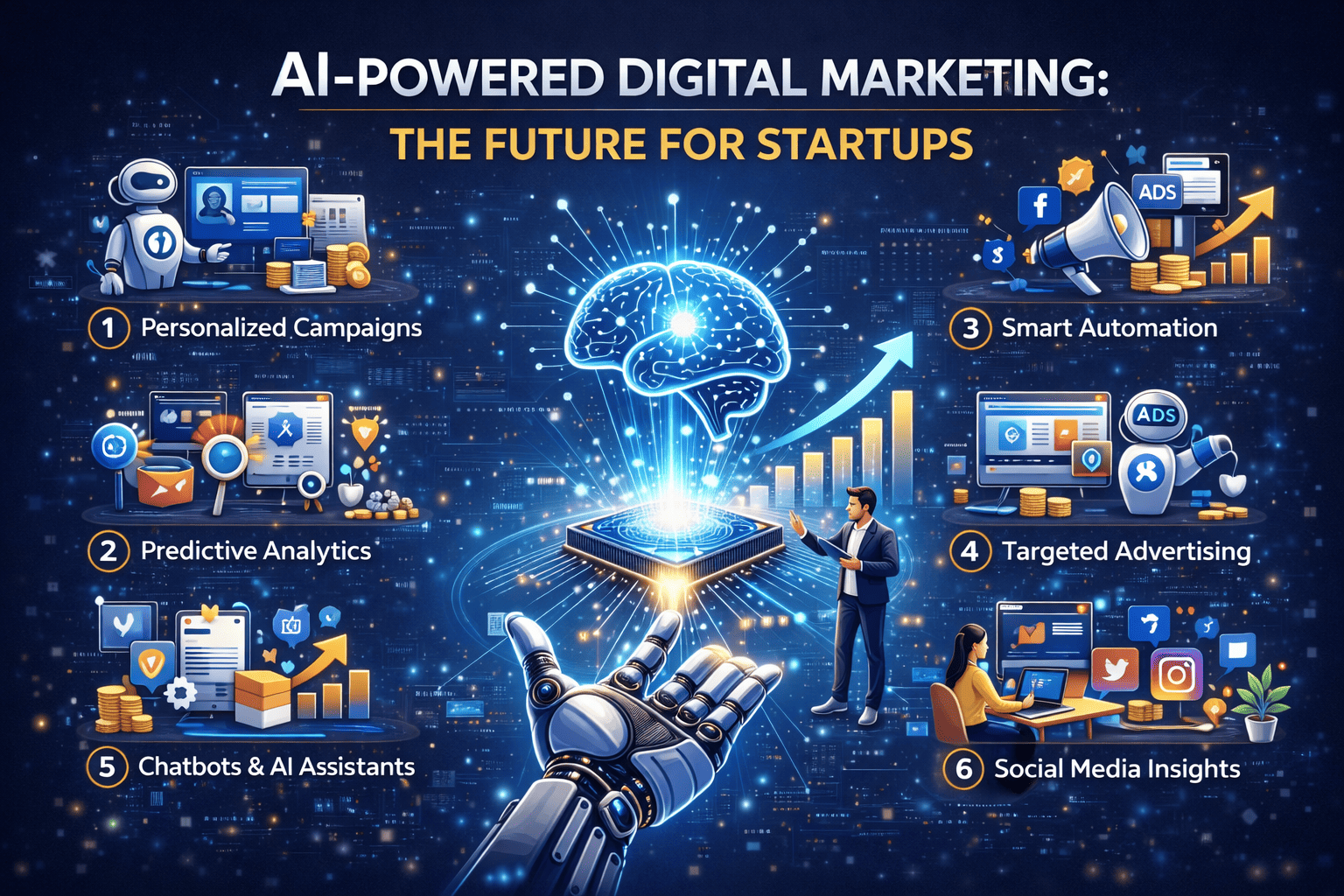
AI-powered digital marketing for Startups operate in highly competitive markets where every marketing dollar matters. Traditional digital marketing methods, while effective in some scenarios, often fall short in providing personalization, real-time optimization, and cost-efficient scaling. This is where AI-powered digital marketing becomes a game-changer.
AI enables startups to analyze data, predict customer behavior, personalize campaigns, and automate repetitive tasks, providing a significant competitive advantage. By leveraging AI, startups can reach the right audience, generate leads faster, and scale marketing efforts with smaller teams and budgets.
In this guide, we’ll explore how AI-powered digital marketing is shaping the future for startups, providing actionable strategies, practical examples, and tools that can help businesses grow rapidly.
1. Understanding AI-Powered Digital Marketing
AI-powered digital marketing uses artificial intelligence technologies to enhance, automate, and optimize marketing campaigns. Unlike traditional approaches, AI focuses on data-driven insights and predictive modeling to make marketing more efficient and personalized.
Key features include:
Predictive analytics for customer behavior
Automated ad targeting and bidding
AI-generated content for blogs, emails, and social media
Chatbots for customer engagement
Personalization at scale
Example: A SaaS startup can use AI to automatically segment users based on behavior and deliver personalized onboarding emails, increasing trial-to-paid conversion rates.
Why it matters for startups:
Maximizes marketing ROI with limited budgets
Reduces manual workload for small teams
Enhances personalization and engagement
Accelerates scaling and growth
2. Benefits of AI-Powered Digital Marketing for Startups
Startups can gain a significant competitive edge by implementing AI in their digital marketing strategy. Here’s how:
a. Data-Driven Decision Making
AI tools analyze large datasets to provide actionable insights, reducing guesswork and improving strategy.
b. Personalization at Scale
AI can create personalized experiences for thousands of customers simultaneously, improving engagement and conversions.
c. Marketing Automation
Automates repetitive tasks like social media posting, email campaigns, ad management, and reporting.
d. Cost Efficiency
By optimizing campaigns and targeting high-value leads, startups can reduce wasted ad spend.
e. Predictive Analytics
AI predicts customer behavior and campaign performance, enabling startups to optimize before launching at scale.
Example: An e-commerce startup uses AI to predict which products customers are likely to buy next, increasing upsells and repeat purchases.
3. AI Tools Every Startup Should Consider
Implementing AI-powered digital marketing requires the right tools. Here are the most effective ones for startups:
a. AI for Content Creation
ChatGPT, Jasper.ai: Generate blogs, social media posts, and email copy quickly.
Canva AI: Create visuals and graphics efficiently.
b. AI for Ads & PPC
Google Ads AI: Smart bidding, keyword optimization, and audience targeting.
Facebook Ads AI: Automated ad placement, audience segmentation, and performance tracking.
c. AI for Email Marketing
HubSpot AI: Predictive lead scoring, automated workflows, and personalization.
Mailchimp AI: Personalized campaigns and engagement tracking.
d. AI for Analytics & Insights
Google Analytics AI & Mixpanel: Predictive analytics and customer behavior insights.
Tableau & Power BI: AI-driven dashboards for data visualization.
e. AI Chatbots & Customer Engagement
Intercom, Drift, ManyChat: AI chatbots for instant responses, lead capture, and 24/7 engagement.
Tip: Startups should prioritize tools that integrate easily with existing marketing channels to maximize efficiency.
4. AI-Powered Customer Segmentation
Segmentation is key to effective marketing. AI enables startups to group customers based on behavior, preferences, and purchase patterns.
Benefits of AI segmentation:
Target high-value customers more effectively
Personalize messaging for higher engagement
Optimize ad spend by focusing on the most responsive segments
Example: A SaaS startup can segment users into free trial users, active users, and churn-risk users, sending tailored campaigns to each group.
5. Personalization and Dynamic Campaigns
Personalization drives engagement and conversions. AI enables startups to deliver dynamic content to users based on their behavior and preferences.
Personalization strategies:
Personalized email subject lines and content
Dynamic landing pages adjusting based on visitor profile
AI-generated product recommendations on websites and apps
Example: An online retail startup uses AI to display product recommendations on the homepage based on the visitor’s browsing history, increasing purchase likelihood by 20%.
6. AI in Social Media Marketing
Social media is a key channel for startups. AI enhances social media marketing by automating posting, analyzing trends, and optimizing campaigns in real-time.
Strategies:
AI-generated content for posts, captions, and visuals
Predictive analytics to determine optimal posting times
Social listening to monitor trends and brand sentiment
Example: A startup offering online courses uses AI to schedule posts on Instagram and LinkedIn when their audience is most active, increasing engagement and sign-ups.
7. AI-Powered Ads and Retargeting
AI improves ad performance by analyzing user data and optimizing targeting, bidding, and creative elements.
Techniques for startups:
Predictive targeting to reach high-intent users
Retargeting campaigns for users who didn’t convert initially
AI-optimized bidding to maximize ROI on limited budgets
Example: A fitness app startup runs AI-powered Facebook retargeting ads for users who downloaded the app but didn’t subscribe to the premium plan. Conversions increased by 35%.
8. Chatbots and Conversational AI
AI chatbots help startups engage visitors in real-time, capture leads, and provide customer support without hiring large teams.
Use cases:
Answer frequently asked questions instantly
Capture emails and qualify leads
Guide users through product demos or sign-ups
Example: A SaaS startup uses Intercom chatbots to provide onboarding support for new users, reducing churn and increasing trial-to-paid conversions.
9. AI in Email Marketing and Automation
AI enables startups to automate email campaigns, segment audiences, and personalize messaging at scale.
Strategies:
Predictive lead scoring to prioritize high-potential leads
Behavior-triggered emails for personalized engagement
Automated follow-ups for abandoned carts or trial users
Example: An e-commerce startup uses AI to send personalized product recommendations via email based on browsing history, boosting repeat purchases.
10. AI-Driven Analytics and Predictive Insights
AI allows startups to make data-driven decisions and predict campaign performance.
Analytics benefits:
Identify trends in customer behavior
Forecast sales and conversion rates
Optimize campaigns before scaling
Example: A SaaS startup uses AI analytics to identify which trial users are likely to churn and sends targeted emails to retain them, improving retention rates by 15%.
11. Scaling Marketing Efforts with AI
Once campaigns are optimized, AI helps startups scale efficiently.
Scaling strategies:
Automate campaigns across multiple channels
Use AI to expand reach to lookalike audiences
Implement multi-channel attribution to identify high-performing channels
Example: A fintech startup expands its AI-powered campaigns from local to global audiences by using predictive targeting and automation, doubling leads within two months.
12. Common Challenges Startups Face with AI Marketing
Challenges:
High initial investment for advanced AI tools
Integrating AI with existing marketing platforms
Ensuring data privacy and compliance
Need for technical expertise
Solutions:
Start with cost-effective AI tools
Use platforms with easy integration and user-friendly interfaces
Focus on first-party data to comply with regulations
Train marketing teams to use AI effectively
13. Future Trends in AI-Powered Digital Marketing
AI in digital marketing is rapidly evolving, and startups need to stay ahead. Key trends include:
Hyper-personalization: Real-time customization of user experiences
Voice and visual search optimization: AI-driven search trends
Automated creative generation: AI creates ad copy, video, and visuals
Predictive customer journeys: AI predicts the next action of users to optimize campaigns
Example: A startup using AI to predict which content users will engage with can push personalized recommendations, improving engagement and lead quality.
Conclusion
Scaling a startup fast requires a structured, data-driven growth marketing strategy. By leveraging AI, content marketing, social media, email, paid campaigns, referrals, and analytics, startups can attract high-quality leads, optimize campaigns, and convert prospects into loyal customers efficiently.
At Beta Digital Marketing, we help startups implement growth marketing strategies that deliver measurable results. By combining experimentation, automation, and performance analysis, we ensure your startup can scale faster, achieve higher ROI, and maintain sustainable growth.
Start implementing these strategies today, track your results, and iterate continuously to accelerate your startup’s growth.