 hello@betadigitalmarketing.com
 +91 9513999901
- Written by: admin
- January 21, 2026
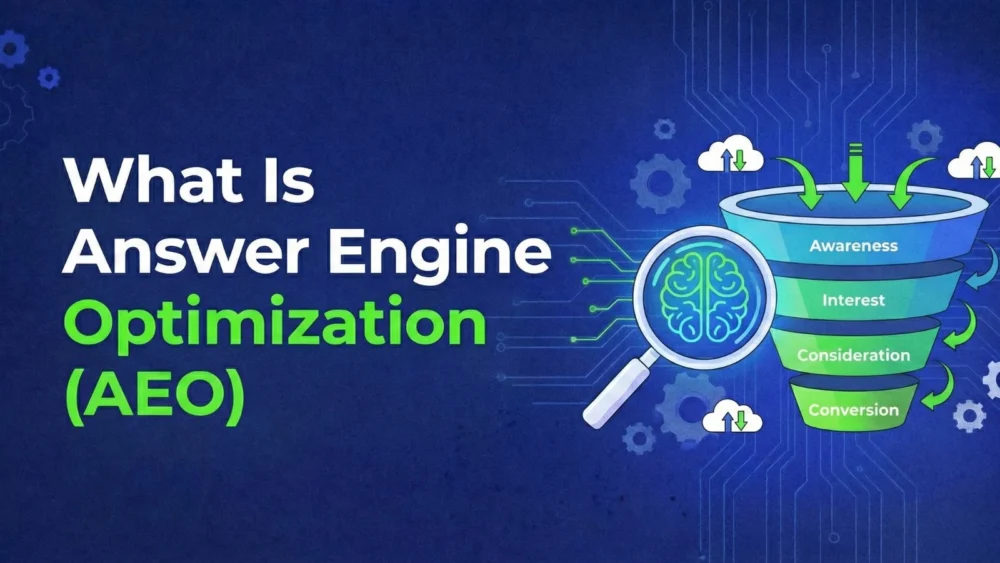
Search behavior is changing faster than ever. People no longer type short keywords and scroll through ten blue links. Instead, they ask full questions and expect direct answers. AI-powered tools, voice assistants, and smart search systems now respond instantly with clear, ready-made answers. This shift has given rise to a new concept called Answer Engine Optimization, commonly known as AEO.
Answer Engine Optimization focuses on helping your content appear as the best possible answer when users ask questions. It goes beyond traditional SEO and aligns your content with how AI systems understand, select, and present information. If you want long-term visibility in the AI era, understanding AEO is no longer optional. It is essential.
What Is Answer Engine Optimization?
Answer Engine Optimization is the process of structuring and writing content so that search engines and AI tools can easily extract and display direct answers to user questions. Instead of optimizing only for rankings, AEO optimizes for response accuracy, clarity, and usefulness.
Traditional SEO focuses on keywords, backlinks, and page authority. AEO focuses on questions, intent, and context. AI-powered engines do not just scan pages. They understand meaning, evaluate relevance, and choose content that provides the clearest and most trustworthy answer.
Why Answer Engine Optimization Matters Today
AI-powered answers now appear everywhere. Voice assistants read answers aloud. Search engines show instant answers at the top of the page. AI chat systems summarize content without sending users to multiple websites.
If your content does not align with this new format, you risk losing visibility even if your SEO is strong.
Answer Engine Optimization matters because:
Users prefer quick, direct answers
AI tools prioritize clarity over keyword density
Zero-click searches are increasing
Authority now comes from helpfulness, not length
Websites that adapt early gain a strong advantage. They become trusted sources that AI systems rely on repeatedly.
How AI-Powered Answer Engines Work
To rank for AI-powered answers, you must understand how these systems think.
AI answer engines follow a simple process. First, they analyze the user’s question. Next, they identify the intent behind it. Then, they scan content sources to find the most relevant and accurate response. Finally, they present the answer in a clear, summarized format.
AI prefers content that:
- Directly answers the question
- Uses simple language
- Follows logical structure
- Demonstrates expertise
- Avoids unnecessary fluff
Your job is to make AI’s work easier. When your content is easy to understand, AI is more likely to select it.
Difference Between SEO and Answer Engine Optimization
Search engine optimisation (SEO) is a vital component of digital marketing, and mobile optimisation directly affects SEO performance. Google has moved to mobile-first indexing, which means it primarily uses the mobile version of a website for ranking purposes. If a website is not mobile-friendly, it may rank lower in search results, reducing organic traffic. Mobile-optimised websites are more likely to appear at the top of search results, attract more visitors, and increase brand exposure. Businesses that invest in mobile optimisation gain a competitive advantage by reaching their audience more effectively. Optimising for mobile includes responsive design, fast loading speeds, and easy navigation, all of which improve search engine rankings.
Understanding User Intent Is the Foundation of AEO
Every answer begins with a question. To succeed in Answer Engine Optimization, you must deeply understand what users are actually asking.
Users usually fall into three intent types:Informational intent
- Navigational intent
- Action-oriented intent
AEO focuses mostly on informational intent. People want explanations, definitions, steps, comparisons, or solutions.
Instead of guessing keywords, think like a user. Ask yourself:
- What problem are they trying to solve?
- What confusion do they have?
- What would a perfect answer look like?
When your content matches the real intent, AI engines reward it.
How to Structure Content for AI-Powered Answers
Structure plays a major role in AEO. AI systems scan content quickly. They look for clear patterns and logical flow.
Start each section with a clear heading that reflects a real question or topic. Follow it with a direct answer in the first few lines. Then expand the explanation naturally.
Avoid long introductions before answering. AI prefers content that gets straight to the point.
Use short paragraphs. Keep sentences simple. Each paragraph should explain one idea only.
When your structure is clean, AI understands your content faster and trusts it more.
Writing Clear and Direct Answers
Clarity is the most important factor in Answer Engine Optimization.
Write as if you are explaining the topic to someone new. Avoid complex words when simple ones work better. Use active voice and confident statements.
For example, instead of saying:
“Answer Engine Optimization can be considered a method that may help websites improve visibility.”
Say:
“Answer Engine Optimization helps websites appear as direct answers in AI-powered search.”
Direct language increases trust. AI engines prefer content that sounds confident and informative.
The Role of Natural Language in AEO
Mobile optimisation is crucial for local businesses. Many users search for nearby restaurants, shops, or services on their phones. Google and other search engines prioritize mobile-friendly websites in local search results. Optimising your website for mobile ensures that your business appears in local searches, maps, and “near me” queries. For example, if someone searches for “best coffee shop near me,” a mobile-optimised website with fast loading and accurate information is more likely to be displayed at the top. This increases foot traffic, online orders, and overall visibility for local businesses.
How Topic Authority Improves Answer Rankings
AI-powered systems favor sources that show depth and consistency.
Instead of writing one article on a topic, build a content cluster. Cover related questions, explanations, and subtopics in separate but connected posts.
Over time, AI recognizes your website as an authority in that area.
Authority grows when your content:
- Stays consistent in quality
- Covers topics thoroughly
- Uses accurate explanations
- Avoids misleading claims
Answer Engine Optimization rewards long-term expertise, not shortcuts.
Importance of Context Over Keywords
Paid advertising campaigns, such as Google Ads or social media ads, also benefit from mobile optimisation. Ads that direct users to non-optimised websites often result in wasted budgets because visitors leave quickly. Mobile-friendly landing pages improve ad performance by increasing engagement, reducing bounce rates, and boosting conversion rates. Businesses that invest in mobile optimisation get better returns on their advertising spend. For example, an online clothing store running Instagram ads will achieve higher sales if the landing page is mobile-responsive and loads quickly, turning clicks into purchases efficiently.
Formatting That Helps AI Extract Answers
Mobile optimisation also caters to changing user behaviour. People prefer browsing on mobile devices because it is convenient and accessible anytime, anywhere. They expect websites to be fast, easy to navigate, and visually appealing on their phones. Businesses that understand this behaviour and optimise their mobile presence meet customer expectations and gain an edge over competitors. Ignoring mobile optimisation can lead to lost opportunities, as users are likely to choose competitors with better mobile experiences. By analysing mobile user behaviour, businesses can improve website design, content placement, and marketing strategies to align with user preferences.
Building Trust Signals in Content
The importance of mobile optimisation will continue to grow in the coming years. Mobile technology is evolving rapidly, with advancements in devices, apps, and mobile payment systems. Augmented reality, voice search, and AI-driven mobile experiences are becoming part of digital marketing strategies. Businesses that prioritise mobile optimisation now will be better prepared to adopt these innovations and stay ahead of competitors. A mobile-optimised website is not just about today’s needs; it is about building a strong digital foundation for future growth. Companies that invest in mobile-first strategies will reach more customers, improve engagement, and increase revenue.
Future of Answer Engine Optimization
The importance of mobile optimisation will continue to grow in the coming years. Mobile technology is evolving rapidly, with advancements in devices, apps, and mobile payment systems. Augmented reality, voice search, and AI-driven mobile experiences are becoming part of digital marketing strategies. Businesses that prioritise mobile optimisation now will be better prepared to adopt these innovations and stay ahead of competitors. A mobile-optimised website is not just about today’s needs; it is about building a strong digital foundation for future growth. Companies that invest in mobile-first strategies will reach more customers, improve engagement, and increase revenue.
Final Thoughts
Mobile optimisation is a critical component of digital marketing. With the increasing number of mobile users, businesses cannot afford to ignore mobile-friendly websites, fast loading speeds, and responsive design. Mobile optimisation improves user experience, search engine rankings, conversions, social media engagement, email marketing, and brand reputation. It also ensures that businesses remain competitive in a fast-changing digital landscape. Companies that focus on mobile optimisation not only meet the expectations of modern users but also gain a significant advantage in digital marketing success. In today’s mobile-driven world, businesses that optimise for mobile are more likely to attract customers, retain them, and grow sustainably. Investing in mobile optimisation is no longer optional; it is essential for every digital marketing strategy.