- Written by: admin
- September 29, 2026
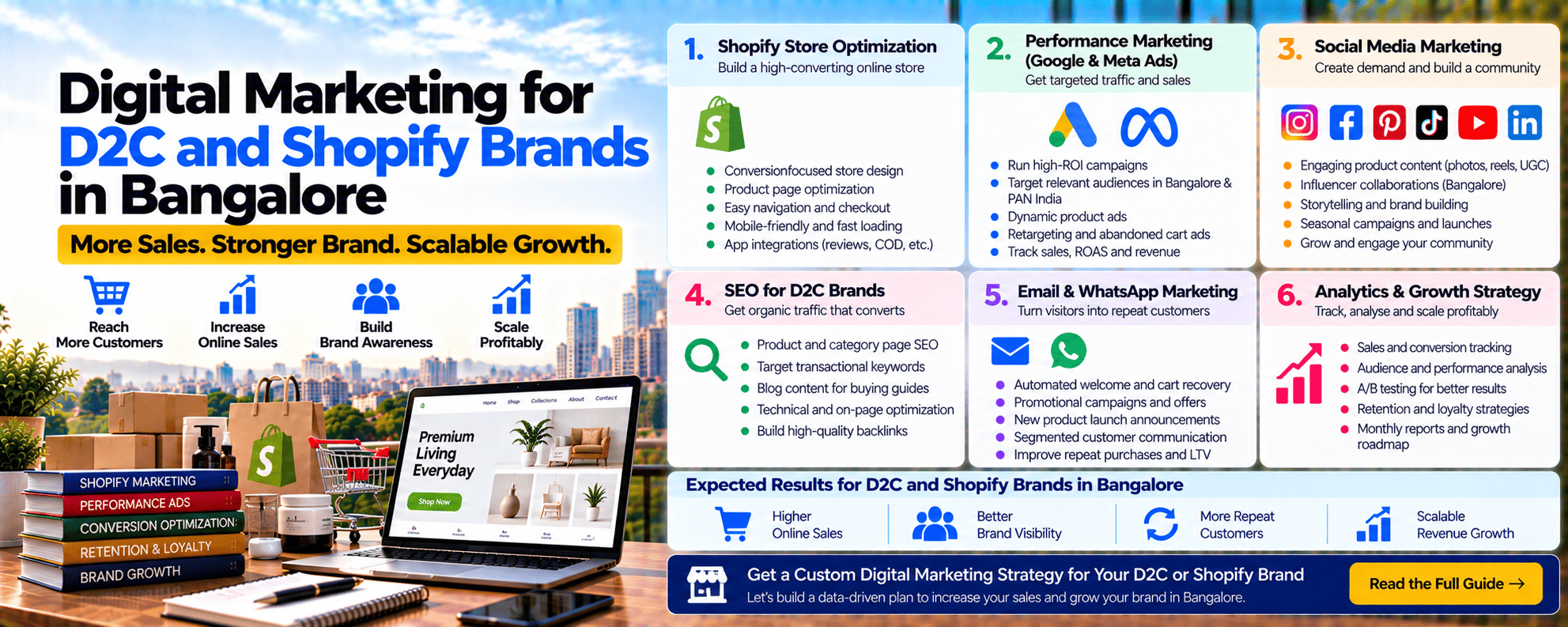
Digital Marketing for D2C and Shopify Brands in Bangalore
Choosing the right D2C marketing agency in Bangalore can decide whether your brand scales profitably or burns cash on ads. Bangalore is one of India’s biggest hubs for direct-to-consumer brands, in skincare, fashion, food, home décor, pet care, and wellness. Many of them run on Shopify and depend on Meta Ads, Google Shopping, and influencers for growth.
But D2C marketing isn’t just “run ads and get sales.” Rising ad costs, cash-on-delivery returns, low repeat rates, and thin margins can turn a brand with good ROAS into one that’s losing money. This guide explains how D2C and Shopify brands can grow profitably, from unit economics and tracking to ads, retention, and reporting.
Start With Unit Economics, Not Ads
Before spending on ads, know these numbers:
| Metric | What It Means | Example |
|---|---|---|
| AOV (average order value) | Average amount per order | ₹900 |
| Contribution margin | What’s left after product, shipping, payment, and packaging costs | 45% (₹405 per order) |
| Break-even ROAS | 1 ÷ contribution margin | 1 ÷ 0.45 = 2.2x |
| CAC (customer acquisition cost) | Ad spend ÷ new customers | ₹350 |
| Repeat purchase rate | Customers who buy again in 6–12 months | 25–40% (consumables) |
| LTV (lifetime value) | Total profit per customer over time | ₹1,200 |
| LTV:CAC ratio | Profit per customer vs cost to acquire | 3:1 or better |
Key lesson: A 2x ROAS sounds good, but if your break-even ROAS is 2.2x, you’re losing money on every first order. The right D2C marketing agency in Bangalore should work from these numbers, not just report ROAS.
10-Step D2C Growth Playbook
Step 1: Fix Tracking First
Without accurate tracking, ad platforms optimise for the wrong things.
- Meta: Install the Meta pixel and Conversions API through Shopify’s Facebook & Instagram app
- Google: Connect the Google & YouTube app for conversion tracking and product feeds
- GA4: Enable ecommerce tracking (view item, add to cart, checkout, purchase)
- UTMs: Tag every influencer, WhatsApp, and email link
See Shopify Help Centre for app setup guides. Don’t know which ad is actually driving sales? See how we fix unclear ad attribution.
Step 2: Improve Your Store’s Conversion Rate
Ads bring visitors, and your store turns them into buyers. Even a small improvement in conversion rate lowers your CAC.
Mobile product page checklist:
- Fast loading (most Indian shoppers are on mobile)
- Clear product photos and short video
- Customer reviews with photos (UGC)
- Size guide or usage instructions
- Delivery time by pincode
- COD and prepaid options clearly shown
- UPI and wallet payment options
- WhatsApp chat button for questions
- Trust signals: returns policy, secure checkout, “Made in India” or ingredient badges
Cart abandonment: Industry research from Baymard Institute puts average online cart abandonment at around 70%. Recovering even a small share through WhatsApp and email makes a big difference.
Need a faster, better-converting store? See our web design services.
Step 3: Run Creative-Led Meta Ads
For most D2C brands, Meta (Instagram and Facebook) is the main growth channel.
What works in 2026:
- Creative is the main lever: Meta’s AI handles much of the targeting, so your ads’ content drives results
- Advantage+ sales campaigns: Let Meta’s AI find buyers, especially once you have enough purchase data
- 5–10 new creatives a month: UGC videos, founder stories, product demos, comparisons, and customer reviews
- Test hooks: The first 2–3 seconds decide whether people watch
- Retargeting: Product viewers and cart abandoners with offers or reviews
Creative types that often work for Indian D2C:
- Unboxing and first-use videos
- “Before and after” (where honest and allowed)
- Founder-led “why we started this brand”
- Comparison with ordinary alternatives
- Regional-language versions for specific states
Ads running but sales not coming? See how we help when ad spend brings no sales.
Step 4: Use Google Shopping and Performance Max
Google captures shoppers searching for products.
- Set up Google Merchant Center with a clean product feed (good titles, prices, images, and availability)
- Run Performance Max for Shopping, YouTube, and Display reach
- Run Search campaigns for your brand name and high-intent category keywords (for example, “vitamin C serum for oily skin”)
- Protect your brand name, since competitors may bid on it
Step 5: Work With Influencers and UGC Creators
- Partner with micro-influencers (10,000–100,000 followers) in your niche
- Use unique discount codes to track sales from each creator
- Repurpose creator content as ads (with permission)
- Build a monthly UGC pipeline for fresh ad creatives
Step 6: Build SEO for Your Shopify Store
SEO brings free traffic that lowers your blended CAC over time.
- Optimise collection pages (“Cotton kurtas for women,” “Organic microgreens in Bangalore”)
- Add product schema (price, availability, reviews)
- Write buying guides (“How to choose a sunscreen for Indian skin”)
- Fix duplicate content from product variants
- Make sure product pages appear in Google AI Overviews and AI shopping answers (see how to rank in Google AI Overviews)
Step 7: Grow Retention With WhatsApp and Email
Getting a first order is expensive. Repeat orders are where D2C profit comes from.
Key automated flows:
- Welcome series: Brand story and first-order offer
- Abandoned cart: WhatsApp and email reminders within 1 hour and 24 hours
- Order updates: Confirmation, shipping, and delivery on WhatsApp
- Post-purchase: Usage tips and a review request
- Reorder reminders: Timed to when the product usually runs out
- Win-back: Offers for customers who haven’t bought in 60–90 days
Explore our Email, SMS and WhatsApp marketing services.
Step 8: Reduce COD Returns (RTO)
In India, cash-on-delivery orders often have much higher return-to-origin (RTO) rates than prepaid orders. RTO costs you shipping both ways and blocks inventory.
How to reduce RTO:
- Confirm COD orders on WhatsApp before shipping
- Offer a small prepaid discount or free shipping on prepaid orders
- Validate addresses and pincodes at checkout
- Flag high-risk pincodes or repeat returners
- Set clear delivery timelines
Step 9: Decide Your Marketplace and Quick Commerce Strategy
Many D2C brands also sell on Amazon, Flipkart, and quick commerce apps like Blinkit, Zepto, and Instamart.
- Use marketplaces for reach and trust
- Use your Shopify store for margin, customer data, and retention
- Keep pricing consistent across channels to avoid confusing customers
- Track which channel brings profitable customers, not just sales
Step 10: Report on Profit, Not Just ROAS
A good D2C report shows:
- MER (marketing efficiency ratio): Total revenue ÷ total marketing spend
- Blended CAC: Total marketing spend ÷ new customers
- First-order profit after ads
- Repeat revenue share
- RTO rate by channel
D2C Benchmarks (India, 2026)
| Metric | Typical Range |
|---|---|
| Store conversion rate | 1–3% |
| Meta Ads ROAS (first order) | 1.5x – 4x |
| Google Shopping ROAS | 2x – 6x |
| Cart abandonment | Around 70% |
| Repeat purchase rate (consumables) | 20–40% in 6 months |
| Email/WhatsApp revenue share | 10–25% of total revenue |
Indicative ranges. Results vary widely by category, price point, and brand strength.
ROI Example: Skincare Brand
| Item | Amount |
|---|---|
| Monthly ad spend | ₹3,00,000 |
| ROAS | 3x |
| Revenue | ₹9,00,000 |
| Orders (AOV ₹900) | 1,000 |
| Contribution margin (45%) | ₹4,05,000 |
| Minus ad spend | −₹3,00,000 |
| Minus agency fee | −₹35,000 |
| First-order profit | ₹70,000 |
Now add repeat purchases: if 30% of these customers reorder once in 6 months, that’s another ₹2.7 lakh in revenue with almost no ad cost. This is why retention matters as much as acquisition.
Illustrative example.
Break-even ROAS for this brand: 1 ÷ 0.45 = 2.2x. Any ROAS below that loses money on first orders unless repeat purchases make up for it.
Metrics That Matter for D2C Brands
| Metric | Where to Check | Healthy Target |
|---|---|---|
| Blended ROAS / MER | Shopify + ad spend | Above break-even ROAS |
| Blended CAC | Total spend ÷ new customers | Falling or stable |
| Conversion rate | Shopify Analytics / GA4 | 1.5%+ and improving |
| Repeat purchase rate | Shopify customer reports | Rising quarter on quarter |
| LTV:CAC | Shopify + ad data | 3:1 or better |
| RTO rate | Shipping dashboard | Falling month on month |
| Cart recovery revenue | WhatsApp/email tools | 5–15% of abandoned carts recovered |
| Creative win rate | Meta Ads Manager | 1–2 winning ads per 10 tested |
How to Choose a D2C Marketing Agency in Bangalore
Ask these questions:
- Do you understand unit economics? They should ask about your margins before promising ROAS.
- Who makes the creatives? D2C growth depends on fresh ad creatives every month.
- Do you handle tracking setup? Pixel, Conversions API, and GA4 should be correct from day one.
- What about retention? WhatsApp and email flows should be part of the plan.
- How do you report? Look for MER, CAC, and profit, not just ROAS and reach.
- Do you have Shopify experience? Store speed, apps, and conversion rate matter.
- Who owns the accounts? Ad accounts, Shopify, and data should be in your name.
For more, read our guide on how to choose a digital marketing agency.
Common D2C Marketing Mistakes
- Scaling ads without knowing break-even ROAS
- Broken or incomplete tracking
- Running the same 3 creatives for months
- Ignoring COD returns and RTO costs
- No retention flows, so every sale depends on ads
- Slow, cluttered mobile store
- Chasing influencers with big follower counts but low engagement
- Judging success by revenue instead of profit
How Beta Digital Marketing Helps D2C and Shopify Brands
At Beta Digital Marketing, we help D2C brands in Bangalore grow profitably:
- Shopify store builds and CRO: Fast, mobile-first stores built to convert
- Tracking setup: Meta pixel, Conversions API, GA4 ecommerce, and Google Ads
- Meta Ads with Advantage+: Creative-led campaigns with a monthly testing plan
- Google Shopping and Performance Max: Clean feeds and profitable campaigns
- WhatsApp and email automation: Cart recovery, COD confirmation, and reorders
- SEO for Shopify: Collection pages, buying guides, and product schema
- Profit-focused reporting: MER, CAC, repeat rate, and RTO
Explore our PPC services, social media marketing packages, and the AI marketing tools we use.
Frequently Asked Questions
What does a D2C marketing agency in Bangalore do?
It helps direct-to-consumer brands grow sales profitably through Meta Ads, Google Shopping, influencers, SEO, store optimisation, and retention marketing like WhatsApp and email.
What is a good ROAS for D2C brands in India?
It depends on your margins. Calculate break-even ROAS (1 ÷ contribution margin). If your margin is 45%, you need at least 2.2x ROAS to break even on first orders.
Is Meta or Google better for D2C brands?
Most D2C brands grow mainly through Meta for discovery, and use Google Shopping and Search to capture existing demand. The best results come from using both.
How can D2C brands reduce COD returns?
Confirm COD orders on WhatsApp, offer prepaid incentives, validate addresses, and flag high-risk pincodes.
How much should a D2C brand spend on marketing?
Early-stage brands often spend ₹50,000–₹3 lakh a month on ads. Scale only when your CAC and repeat rate make the numbers profitable.
Get a Free D2C Growth Audit
Getting sales but not profit? Get a free D2C growth audit from Beta Digital Marketing. We’ll review your tracking, store conversion rate, ad creatives, and retention flows, and show you where you’re losing money and how to fix it.
📞 +91 95139 99901 | ✉️ hello@betadigitalmarketing.com | Book your free audit →