- Written by: admin
- September 29, 2026
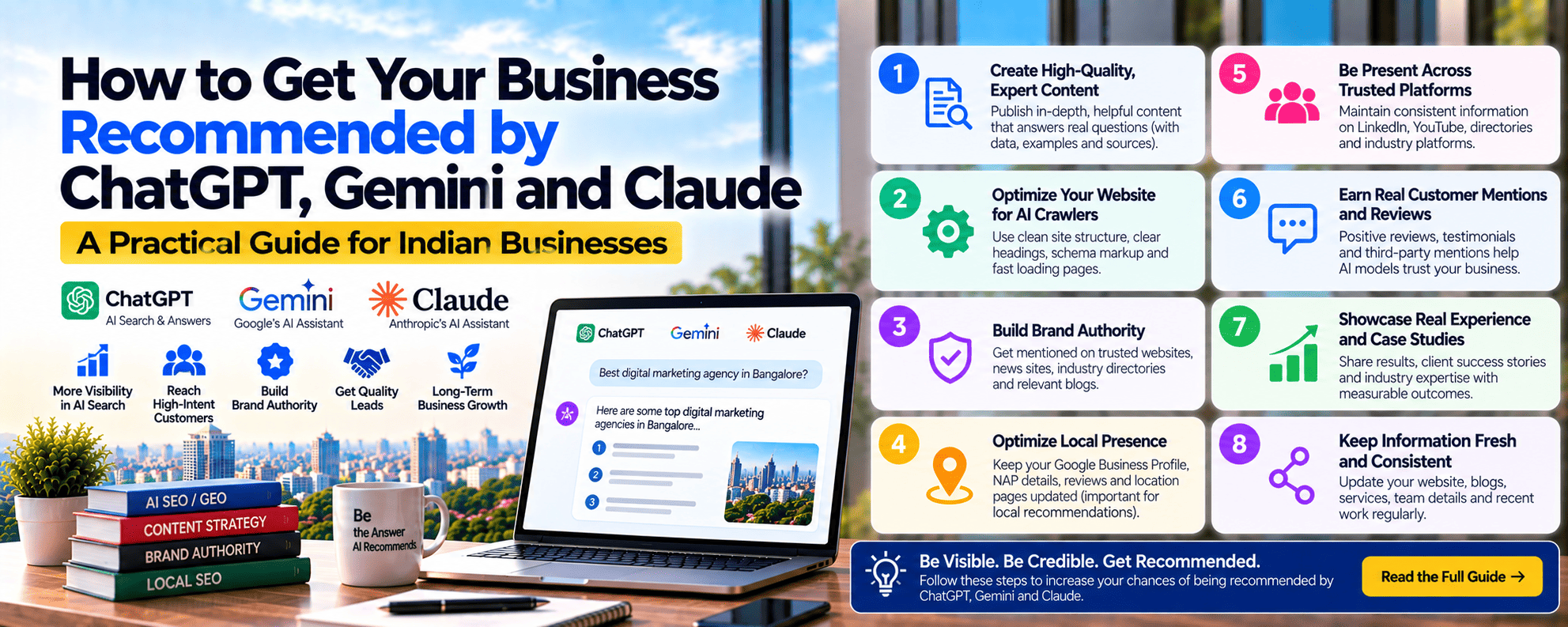
How to Get Your Business Recommended by ChatGPT, Gemini and Claude
If you’re wondering how to get recommended by ChatGPT, you’re asking the right question at the right time. More customers now ask AI tools things like “best dermatologist in Indiranagar,” “top interior designers in Bangalore,” or “which CRM software is good for small businesses in India.” The AI replies with 3–5 names. If your business isn’t one of them, you’re invisible to that customer.
The good news: AI recommendations aren’t random, and you can’t buy them. They’re based on what the internet says about your business. This guide explains how AI tools choose which businesses to recommend, and 9 practical steps to get your business named by ChatGPT, Gemini, and Claude.
What Does “Recommended by AI” Actually Mean?
Customers use AI in three main ways when looking for a business:
| Prompt Type | Example | What AI Does |
|---|---|---|
| “Best” questions | “Best physiotherapy clinic in HSR Layout” | Lists 3–5 businesses |
| Comparison questions | “Is Company A or Company B better for SEO?” | Compares brands it knows |
| Advice questions | “Who should I hire to build an e-commerce website in Bangalore?” | Suggests types of businesses, sometimes named ones |
Being recommended means appearing by name in these answers, ideally with a positive description and a link.
How Do ChatGPT, Gemini and Claude Choose Businesses?
AI tools usually rely on two sources:
- What they learned during training: Information from across the web up to a certain date.
- Live web search: When search is used, the AI reads current web pages, reviews, and directories, then summarises them.
For business recommendations, live search matters most. The AI often looks at:
- “Top 10” and “best of” list articles
- Review sites and Google reviews
- Directories (Justdial, Clutch, GoodFirms, IndiaMART, Practo)
- Your website’s service and about pages
- Reddit, Quora, and forum discussions
- News articles and industry publications
In simple words: AI recommends businesses that many trusted sources describe clearly and positively.
How Each AI Tool Tends to Find Businesses
| AI Tool | Where It Often Looks | What to Focus On |
|---|---|---|
| ChatGPT | Web search results, list articles, review sites, your website | “Best of” lists, clear service pages, reviews |
| Gemini | Google’s ecosystem, including Search, Maps, and Business Profiles | Google Business Profile, Google reviews, strong SEO |
| Claude | Web search (when enabled), well-structured and factual pages | Clear, factual, well-sourced content |
| Perplexity | Live web search with visible citations | Pages that directly answer the question |
| Google AI Overviews | Google Search index | Strong SEO and answer-first content |
Google explains how its AI features use websites in its guide on AI features and your website.
How to Get Recommended by ChatGPT: 9 Steps
Step 1: Find the Prompts Your Customers Use
List 15–25 questions your customers might ask AI. Mix “best,” comparison, and advice prompts.
Examples for a Bangalore interior designer:
- “Best interior designers in JP Nagar”
- “Affordable 2BHK interior designers in Bangalore”
- “Interior designer vs modular kitchen company: which is better?”
Test each one in ChatGPT, Gemini, Claude, and Perplexity. Record who gets recommended and which websites are cited. This tells you exactly where AI is getting its information.
Step 2: Get Listed Where AI Is Already Looking
This is the fastest win. If Perplexity or ChatGPT cites “Top 10 Interior Designers in Bangalore” articles, directories, or review sites, you need to be on those pages.
Actions:
- Contact the authors of popular “best of” list articles and ask to be reviewed
- Create complete profiles on the directories that keep appearing (Justdial, Clutch, GoodFirms, Practo, IndiaMART, Houzz, and others)
- Ask happy clients to leave reviews on those platforms
Step 3: Strengthen Your Google Business Profile and Reviews
For local businesses, this matters especially for Gemini and Google AI Overviews.
- Complete every field in your Google Business Profile: services, areas served, hours, photos, and Q&A
- Aim for 5–10 new genuine Google reviews every month
- Reply to every review, including negative ones
- Ask customers to mention the specific service and area (for example, “great modular kitchen work in our JP Nagar flat”)
If negative reviews are holding you back, see how we help businesses whose bad reviews are hurting trust.
Step 4: Make Your Website Easy for AI to Understand
AI tools can only recommend you accurately if your website states clear facts. Every business should have:
- A clear About page: Who you are, since when, where you operate, and who you serve
- Service pages: One page per service, with areas, prices or price ranges, and process
- A results page: Case studies with real numbers
- FAQ sections: Answers to common customer questions in 2–3 sentences
Weak: “We provide world-class solutions for all your needs.”
Strong: “We design 2BHK and 3BHK interiors in South Bangalore, with projects from ₹4 lakh to ₹15 lakh, completed in 45–60 days.”
Step 5: Publish Honest Comparison and Guide Content
AI tools love content that helps people choose. Write helpful guides on your website, such as:
- “How to choose an interior designer in Bangalore”
- “Cost of 2BHK interiors in Bangalore in 2026”
- “Modular kitchen vs carpenter-made kitchen: pros and cons”
Keep them honest and useful, not just sales pages. Helpful content is more likely to be cited.
Step 6: Earn Mentions on Reddit, Quora, LinkedIn and Local Media
AI tools often trust what real people say about a brand.
- Quora and Reddit: Give genuinely helpful answers in your area of expertise. Mention your business only where it’s relevant, and never spam.
- LinkedIn: Founders and team members should post regularly about their expertise.
- Local media and blogs: Offer expert quotes, guest articles, or interviews.
- Industry associations: Get listed as a member or partner.
Step 7: Keep Your Business Details Consistent Everywhere
Your business name, address, phone, website, and services should be the same everywhere online. Add Organization or LocalBusiness schema to your website, with sameAs links to your LinkedIn, Facebook, Instagram, Google Business Profile, and directory profiles. This helps AI connect all mentions to the same business.
Step 8: Let AI Crawlers Read Your Website
Check your robots.txt file so you’re not blocking AI crawlers such as OpenAI’s GPTBot (OpenAI crawler documentation). Consider adding an llms.txt file that summarises your business. Our guide on what generative engine optimization is explains these technical steps in detail.
Step 9: Keep Content Fresh and Test Every Month
- Update service pages, prices, and FAQs every 3–6 months
- Add new case studies and reviews regularly
- Re-test your 15–25 prompts every month to track progress
What Doesn’t Work (and Can Backfire)
| Tactic | Why It Fails |
|---|---|
| Paying for ChatGPT placement | You can’t buy organic AI recommendations |
| Fake reviews | Platforms remove them, and they damage trust |
| Asking ChatGPT to “remember” your business | Your own chats don’t change what AI tells other users |
| Spamming Reddit or Quora | Gets removed and harms your reputation |
| Mass AI-written pages with no real facts | Rarely cited, and can hurt SEO |
| Keyword stuffing “best company” everywhere | AI looks for real evidence, not repeated claims |
Examples by Industry
| Business | Priority Actions |
|---|---|
| Clinic / hospital | Google reviews, Practo profile, doctor bio pages, treatment cost FAQs |
| Interior designer | Houzz and Justdial listings, project case studies, “best of” list outreach |
| IT training institute | Course pages with fees and duration, student reviews, Quora answers |
| B2B manufacturer | IndiaMART profile, product specs pages, industry directory listings |
| Digital marketing agency | Clutch and GoodFirms reviews, case studies, LinkedIn thought leadership |
| Restaurant / café | Google and Zomato reviews, menu with prices, local food blogger features |
How to Track AI Recommendations
Free Prompt Tracking Sheet
Create a simple Google Sheet like this:
| Prompt | ChatGPT | Gemini | Claude | Perplexity | Competitors Named | Sources Cited |
|---|---|---|---|---|---|---|
| Best interior designer in JP Nagar | ❌ | ✅ | ❌ | ✅ | Company X, Company Y | Justdial, Houzz |
| 2BHK interior cost Bangalore | ✅ | ✅ | ❌ | ✅ | Company Z | Your blog |
Test once a month and compare over time.
Metrics to Measure
| Metric | How to Track | Healthy Target |
|---|---|---|
| AI recommendation rate | % of prompts where you’re named | 20–40% by month 6 |
| AI referral traffic | GA4 → sessions from chatgpt.com, perplexity.ai, gemini.google.com | Growing month on month |
| Leads from AI referrals | GA4 conversion events | Tracked and rising |
| Branded searches | Google Search Console | 15–30% growth in 6 months |
| New reviews per month | Google Business Profile | 5–10+ |
| Directory and list mentions | Manual count | 3–5 new per quarter |
Tip: ChatGPT often adds utm_source=chatgpt.com to links it shares, so these visits can show up clearly in GA4 under traffic source.
ROI example: A dental clinic works on AI visibility for 6 months at ₹15,000/month. It starts getting 20 leads a month from AI referrals and branded searches. If 6 become patients at ₹10,000 each, that’s ₹60,000 a month.
ROI = (60,000 − 15,000) ÷ 15,000 × 100 = 300%.
How Long Does It Take?
| Timeframe | What to Expect |
|---|---|
| Month 1 | Baseline testing, directory profiles, website fixes |
| Months 2–3 | Appearing in some Perplexity and Gemini answers (these use live search) |
| Months 4–6 | More regular recommendations across tools, more AI referral traffic |
| 6+ months | Stronger, more consistent recommendations as mentions and reviews grow |
Understanding how to get recommended by ChatGPT is a long-term effort, like SEO. The businesses that start now will be much harder to catch in a year.
How Beta Digital Marketing Helps Businesses Get Recommended by AI
At Beta Digital Marketing, we help Bangalore and Indian businesses become visible in AI answers:
- AI recommendation audit: We test 20+ customer prompts across ChatGPT, Gemini, Claude, and Perplexity
- Source mapping: We find which lists, directories, and sites AI uses in your industry
- Listing and review strategy: Complete profiles and genuine review generation
- Website optimization: Clear facts, FAQs, schema, and AI crawler setup
- Monthly AI visibility reports: Recommendation rate, competitors, and AI referral traffic
This work is part of our SEO plans, starting from ₹12,000/month. See how we help businesses that are invisible on ChatGPT and AI search, read our AI SEO pricing guide, or learn about our GMB local SEO service.
Frequently Asked Questions
How to get recommended by ChatGPT for my business?
Get listed on the directories and “best of” lists AI already cites, build genuine reviews, make your website facts clear, earn mentions on trusted sites, and keep your business details consistent everywhere.
Can I pay to appear in ChatGPT recommendations?
No. Organic AI recommendations can’t be bought. They’re earned through reviews, mentions, and clear, trustworthy content.
Why does ChatGPT recommend my competitors but not me?
Usually because competitors have more reviews, appear on more list articles and directories, or have clearer information on their websites.
How do I get recommended by Gemini?
Focus on your Google Business Profile, Google reviews, and strong SEO, since Gemini is closely connected to Google’s ecosystem.
How long does it take to get recommended by AI?
Usually 2–6 months. Tools using live search, like Perplexity, can reflect changes faster.
Get a Free AI Recommendation Audit
Want to know if ChatGPT, Gemini, and Claude recommend your business, and who they recommend instead? Get a free AI recommendation audit from Beta Digital Marketing. We’ll test 20 customer prompts, map the sources AI uses, and show you what to fix first.
📞 +91 95139 99901 | ✉️ hello@betadigitalmarketing.com | Book your free AI audit →