 hello@betadigitalmarketing.com
 +91 9513999901
- Written by: admin
- March 10, 2026
Introduction
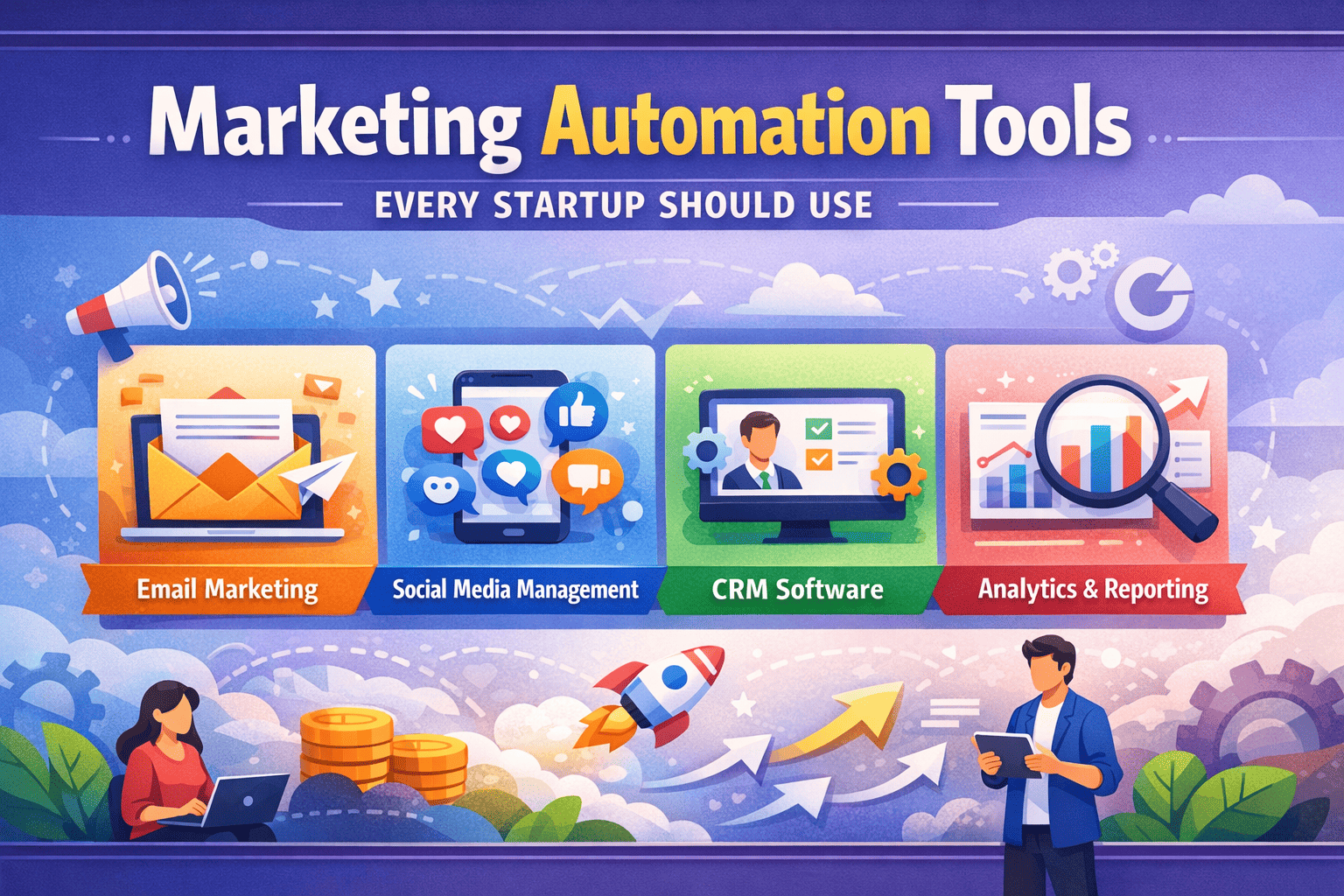
Marketing automation tools for startups help businesses save time, generate leads, and scale faster without increasing marketing costs. Startups move fast. One day you are trying to get your first 100 leads, and the next day you are managing emails, social media, customer follow-ups, sales calls, and support messages all at once. In that kind of environment, doing everything manually is not only stressful, it also slows down growth. That is where marketing automation tools become essential.
Marketing automation helps startups save time, improve consistency, generate better leads, and build stronger customer relationships without needing a huge team. Instead of repeating the same tasks every day, founders and marketers can automate email campaigns, lead nurturing, customer segmentation, social posting, analytics, and even sales follow-ups. This gives startups more time to focus on strategy, product improvement, and revenue growth.
In this blog, we will explore the best marketing automation tools every startup should use, why these tools matter, and how they can help you scale smarter. Whether you are in SaaS, eCommerce, education, B2B services, or any other startup niche, the right automation stack can transform your growth journey.
AI is transforming digital marketing for startups by enabling smarter decisions, automating tasks, delivering personalized experiences, and optimizing campaigns. Startups adopting AI-driven strategies can compete with established brands, achieve better ROI, and grow efficiently.
At Beta Digital Marketing, we specialize in helping startups implement AI in their marketing strategies. From AI-powered content creation to predictive analytics, our solutions ensure your startup scales faster while maintaining efficiency and cost-effectiveness.
AI is no longer a futuristic concept—it’s a vital tool for startups aiming to succeed in today’s digital-first world. Embrace AI now to stay ahead of the competition and maximize your startup’s growth potential.
Why Marketing Automation Matters for Startups
Startups usually work with limited budgets, small teams, and big goals. That combination makes efficiency extremely important. Marketing automation allows a startup to do more with fewer resources. Instead of hiring a large team too early, a startup can use smart tools to handle repetitive work and maintain a strong customer journey.
For example, when a visitor signs up on your website, an automation platform can instantly send a welcome email, add the lead to your CRM, assign a score based on behavior, and trigger a follow-up campaign. Without automation, all of this would need manual effort, and delays could cost valuable conversions.
Marketing automation also improves customer experience. People expect quick replies, relevant emails, personalized offers, and smooth communication. Automation tools help startups meet those expectations at scale. This means better engagement, more qualified leads, and higher conversions over time.
1. HubSpot – The All-in-One Marketing Automation Platform
HubSpot is one of the most popular marketing automation tools for startups, and for good reason. It combines CRM, email marketing, lead management, landing pages, automation workflows, analytics, and sales tools in one place. For startups that want a complete growth platform, HubSpot is often a top choice.
The biggest strength of HubSpot is ease of use. Many startups do not have a full technical team, so they need a platform that is simple to set up and manage. HubSpot offers a clean interface and automation features that are beginner-friendly while still being powerful.
With HubSpot, startups can create automated email sequences, track lead activity, manage contacts, build forms, and nurture prospects through the entire sales funnel. It is especially useful for B2B startups, SaaS companies, and service businesses that need strong lead generation and customer relationship management.
2. Mailchimp – Best for Email Marketing Automation
Mailchimp is a strong option for startups that want to focus on email marketing automation without getting overwhelmed by too many advanced tools at the beginning. It is known for its user-friendly design, ready-made templates, and simple campaign setup.
For early-stage startups, email remains one of the highest ROI marketing channels. Mailchimp helps automate welcome emails, abandoned cart reminders, product announcements, newsletters, and drip campaigns. This means a startup can stay connected with leads and customers even when the team is busy with other priorities.
Mailchimp also offers audience segmentation, A/B testing, analytics, and integrations with websites and eCommerce platforms. If your startup wants a practical and affordable way to automate communication, Mailchimp can be a strong starting point.
3. ActiveCampaign – Best for Advanced Email and CRM Automation
ActiveCampaign is ideal for startups that want deeper automation and smarter customer journeys. It combines email marketing, CRM, lead scoring, and advanced workflow automation in one platform. Compared to simpler tools, ActiveCampaign gives more control over how and when users move through campaigns.
This tool is especially useful for startups that rely heavily on nurturing leads over time. For example, if someone downloads a guide, visits your pricing page, and opens multiple emails, ActiveCampaign can detect that behavior and trigger highly targeted follow-ups.
The platform also helps startups improve conversions by sending personalized messages based on user actions. This level of automation is valuable for SaaS startups, coaching businesses, online service providers, and digital product companies that need a more behavior-driven marketing system.
4. Zapier – Best for Connecting Different Tools
Zapier is not a traditional marketing platform, but it is one of the most important automation tools a startup can use. It connects different apps and allows them to work together automatically. In simple words, it acts like a bridge between your software tools.
For example, when someone fills out a contact form on your website, Zapier can send that lead to your CRM, notify your sales team in Slack, add the person to an email list, and create a task in your project management tool. This removes manual copying and pasting between systems.
Startups often use many tools at once, such as Google Sheets, Gmail, Slack, Mailchimp, Trello, HubSpot, and Typeform. Zapier helps connect all these apps into one smooth workflow. It is especially useful for lean teams that want to reduce manual operations and improve efficiency quickly.
5. Hootsuite or Buffer – Best for Social Media Automation
Social media can drive awareness, engagement, and traffic for startups, but posting manually every day takes time. That is why social media automation tools like Hootsuite and Buffer are valuable. These tools let startups schedule posts in advance, manage multiple platforms, and analyze performance from one dashboard.
With Buffer or Hootsuite, a startup can plan a full week or month of content in one sitting. That means less daily stress and more consistent posting. Consistency matters on social media because it helps build brand presence and audience trust over time.
These tools are especially useful for startups building organic reach on platforms like LinkedIn, Instagram, X, and Facebook. They also help with collaboration if multiple team members are involved in content approval or publishing.
6. Brevo – Best for Budget-Friendly Automation
Brevo, previously known as Sendinblue, is another strong marketing automation platform for startups that want affordability without losing essential features. It offers email marketing, SMS campaigns, automation workflows, CRM features, and transactional email support.
One of Brevo’s biggest advantages is value for money. Startups that cannot invest heavily in expensive platforms often find Brevo to be a smart option. It supports welcome journeys, behavior-based emails, lead segmentation, and campaign reporting.
Brevo is particularly useful for startups that want to mix email and SMS in their marketing. For example, a startup can send an email campaign for awareness and follow it with an SMS reminder for action. That combination can improve engagement and conversions in many industries.
7. Salesforce Marketing Tools – Best for Growing Startups
Salesforce may not be the first choice for every early-stage startup, but it becomes highly relevant when a startup starts growing fast and needs enterprise-level systems. Salesforce provides powerful CRM and marketing automation capabilities for businesses that need advanced tracking, customization, and reporting.
Startups with larger sales teams, complex pipelines, or high-value customers may benefit from Salesforce as they scale. It supports lead management, workflow automation, customer segmentation, and detailed analytics. While it may require more setup and training, it offers strong long-term flexibility.
For startups planning rapid expansion, Salesforce can be a platform that grows with the business. It is often better suited for later-stage startups rather than very small teams just getting started.
8. Google Analytics and Tag Manager – Best for Tracking and Optimization
No startup should invest in marketing automation without proper tracking. Google Analytics and Google Tag Manager are essential tools for understanding how users behave on your website and where your leads are coming from. While they are not classic automation tools, they are critical to making automation smarter.
Google Analytics helps you see traffic sources, user journeys, page performance, conversion paths, and audience behavior. Google Tag Manager makes it easier to set up tracking codes and events without constant developer support.
When combined with email and CRM tools, these platforms help startups build more accurate automation. For example, you can identify which landing page brings the best leads and then create automated campaigns specifically for that audience segment. Data-driven automation always performs better than guesswork.
How to Choose the Right Marketing Automation Tools for Your Startup
Not every startup needs every tool. The best approach is to choose based on your current stage, budget, team size, and growth goals. If you are just starting out, an email platform, a CRM, and a simple automation connector may be enough. As your startup grows, you can add deeper analytics, advanced workflows, and sales integration.
Start by identifying your biggest time-consuming tasks. Are you struggling with email follow-ups, lead tracking, social posting, or app integration? Once you know the problem, choosing the right tool becomes easier.
Also, think about integration. Your tools should work well together. A disconnected tech stack creates more confusion, not less. Look for tools that connect smoothly with your website, forms, CRM, and communication channels. This helps create a seamless marketing system that supports long-term growth.
Common Mistakes Startups Should Avoid
One common mistake is choosing tools that are too complex too early. A startup does not need enterprise-level software if it is still finding product-market fit. Overcomplicated tools can waste money, create confusion, and slow adoption.
Another mistake is automating bad processes. Automation does not fix weak messaging or poor strategy. It simply scales what already exists. If your emails are unclear or your funnel is broken, automation will not solve that on its own. Start with a strong foundation, then automate.
Many startups also forget to monitor performance. Once automation is live, it still needs review and optimization. Open rates, click rates, conversion rates, and drop-off points should be checked regularly. Marketing automation works best when it is actively improved over time.
Conclusion
Marketing automation is no longer optional for startups that want to grow efficiently. It saves time, improves customer experience, supports lead nurturing, and creates a more scalable business model. With the right tools, even a small startup team can build professional, personalized, and high-converting marketing systems.
Platforms like HubSpot, Mailchimp, ActiveCampaign, Zapier, Buffer, Brevo, Salesforce, and Google Analytics each bring unique value. The best choice depends on your business needs, but the goal remains the same: reduce manual effort and increase smart, consistent growth.
If your startup is still handling everything manually, now is the right time to begin building an automation stack. Start small, choose wisely, and optimize as you grow. The sooner you automate the right tasks, the faster your startup can focus on what matters most—building, scaling, and winning in the market.