 hello@betadigitalmarketing.com
 +91 9513999901
- Written by: admin
- March 7, 2026
Introduction
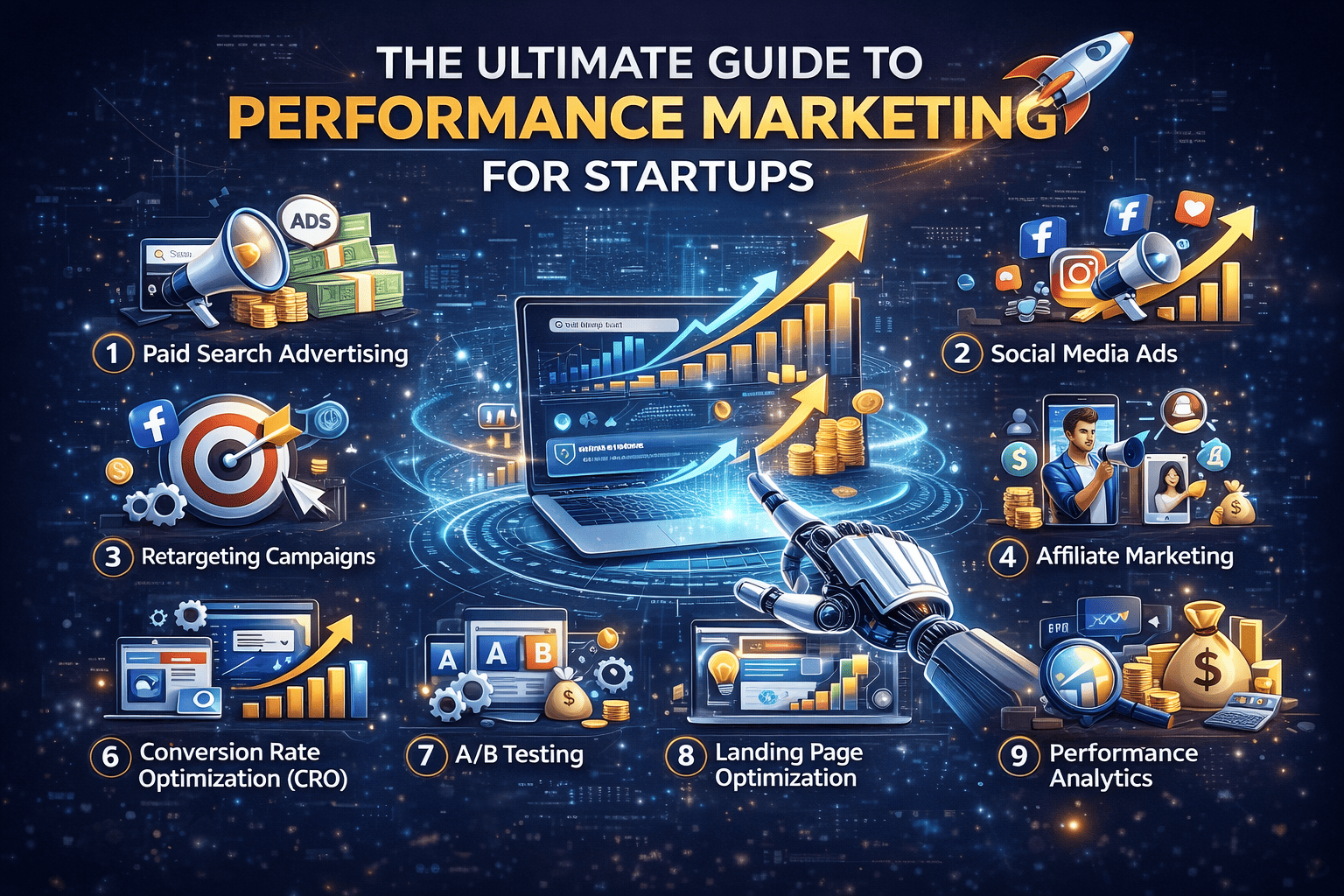
performance marketing for startups Startups operate in a high-stakes, competitive environment where every marketing dollar counts. Unlike traditional marketing, which focuses on brand awareness or long-term impressions, performance marketing is results-driven. It measures success based on actions like clicks, leads, conversions, and sales.
For startups, performance marketing is a game-changer. It allows you to:
Track campaigns in real-time
Allocate budgets efficiently
Optimize campaigns continuously
Achieve measurable ROI
In this ultimate guide, we’ll explore what performance marketing is, why it matters for startups, key channels, strategies, and best practices. By the end, you’ll have a blueprint to launch and optimize campaigns that deliver real growth.
1. What Is Performance Marketing?
Performance marketing is a digital marketing approach where advertisers pay only for measurable results. Unlike traditional marketing, which focuses on visibility, performance marketing ties costs to outcomes.
Key aspects include:
Pay-per-click (PPC): You pay when someone clicks your ad.
Affiliate Marketing: You pay partners only when they generate leads or sales.
Cost-per-acquisition (CPA): You pay for each customer acquired.
For startups, this model is ideal because it reduces risk and ensures every marketing dollar contributes to measurable results.
2. Why Performance Marketing Matters for Startups
Startups often face limited budgets, small teams, and the need to scale quickly. Performance marketing addresses these challenges by:
Providing measurable ROI: Know exactly which campaigns are generating revenue.
Optimizing budgets: Focus spending on channels and strategies that convert.
Driving rapid growth: Test multiple campaigns and scale successful ones.
Reducing risk: Only pay for results, not impressions or reach.
Example: A SaaS startup can run a PPC campaign on Google Ads. Instead of paying for ad space, they pay only when someone clicks and signs up for a trial, ensuring budget efficiency.
3. Key Performance Marketing Channels
To succeed, startups should focus on the most effective performance marketing channels:
a. Paid Search / PPC Advertising
Platforms: Google Ads, Bing Ads
Best for: High-intent traffic and immediate conversions
Strategy: Bid on high-converting keywords, create compelling ad copy, and optimize landing pages
b. Social Media Advertising
Platforms: Facebook, Instagram, LinkedIn, TikTok
Best for: Brand awareness + lead generation
Strategy: Use precise targeting (interests, behavior, demographics), retarget visitors, and A/B test ad creatives
c. Affiliate Marketing
Partners promote your products and earn a commission for sales or leads
Ideal for: Reaching audiences beyond your own channels
Tools: ShareASale, CJ Affiliate, Impact
d. Email Marketing
Track clicks, conversions, and sign-ups
Automation helps scale campaigns while staying personalized
Segment audience for better targeting and engagement
e. Display & Retargeting Ads
Display ads on websites your audience visits
Retarget users who visited your site but didn’t convert
Tools: Google Display Network, AdRoll
4. Performance Marketing Metrics Startups Must Track
To measure success, startups need to track key metrics:
Click-Through Rate (CTR): Percentage of users clicking your ad
Conversion Rate (CVR): Percentage of users completing desired action
Cost-per-Acquisition (CPA): How much it costs to acquire one customer
Return on Ad Spend (ROAS): Revenue generated compared to ad spend
Lifetime Value (LTV): Revenue expected from a customer over their relationship with your startup
Tracking these metrics allows startups to optimize campaigns, allocate budgets effectively, and make data-driven decisions.
5. Strategies for Performance Marketing Success
a. Set Clear Goals
Define what “performance” means for your startup: leads, sales, app installs, subscriptions
Ensure all campaigns align with these goals
b. Understand Your Audience
Create buyer personas based on demographics, behavior, and pain points
Use analytics tools and surveys to refine targeting
c. Optimize Landing Pages
Clear headlines, strong CTAs, and social proof improve conversions
Mobile-friendly and fast-loading pages reduce bounce rates
d. Use A/B Testing
Test ad creatives, copy, landing page designs, and CTAs
Scale strategies that perform well and eliminate low-performing ones
e. Leverage Automation & AI
AI tools can optimize bids, ad copy, and targeting in real-time
Automation helps scale campaigns efficiently without increasing manual work
6. Tips for Cost-Efficient Performance Marketing
Startups must maximize ROI while minimizing spend:
Start Small, Scale Fast: Test campaigns with minimal budget before scaling successful ones
Retargeting: Convert users who already engaged with your brand
Focus on High-Intent Keywords: For PPC, target keywords with strong purchase intent
Leverage Organic Channels: Combine paid campaigns with SEO and content marketing for cost efficiency
Monitor Daily: Check metrics regularly to pause underperforming campaigns quickly
7. Common Mistakes Startups Should Avoid
Not defining goals: Leads to wasted spend and unclear ROI
Ignoring analytics: Decisions should be data-driven, not assumptions
Overcomplicating campaigns: Start simple, iterate based on results
Ignoring mobile users: Most users now access ads and websites via mobile
Neglecting creative quality: Poor ad copy or visuals reduce CTR and conversions
8. Tools Every Startup Should Use for Performance Marketing
Analytics & Tracking: Google Analytics, Mixpanel, Hotjar
Advertising & PPC: Google Ads, Facebook Ads Manager, LinkedIn Ads
Email Marketing: Mailchimp, HubSpot, ActiveCampaign
Affiliate Management: ShareASale, Impact, CJ Affiliate
Landing Pages & CRO: Unbounce, Leadpages, Instapage
Automation & AI: Zapier, HubSpot AI, AdRoll AI
9. Case Study: Startup Performance Marketing Success
Scenario: A SaaS startup offering project management software wanted to increase trial sign-ups.
Strategy:
Launched Google Ads targeting high-intent keywords
Retargeted visitors with personalized social media ads
Optimized landing pages with clear CTAs and testimonials
Automated email sequences for trial users
Results:
35% increase in trial sign-ups in 3 months
25% decrease in CPA
Improved ROAS by 40%
This example shows how startups can achieve measurable growth with a structured performance marketing approach.
10. Future of Performance Marketing for Startups
Performance marketing is evolving with AI, automation, and data-driven personalization. Startups can expect:
AI-powered predictive analytics to forecast conversions and optimize campaigns
Automation of campaign management for faster scaling
Cross-channel attribution to understand which channels drive the most ROI
Hyper-personalized experiences to increase engagement and lifetime value
Startups adopting these innovations will remain competitive and scale faster than those relying on traditional marketing.
Conclusion
Performance marketing for startups is all about measurable results, data-driven decisions, and continuous optimization. By leveraging AI, automation, and the right channels, startups can maximize ROI, attract high-quality leads, and accelerate growth efficiently.
At Beta Digital Marketing, we help startups implement performance marketing strategies tailored to their goals. From campaign planning and execution to analytics and optimization, we ensure every marketing dollar drives measurable results.
Start implementing these strategies today, track your metrics, iterate quickly, and watch your startup scale successfully.